
This site uses cookies. By continuing to browse the site, you are agreeing to our use of cookies.
💼 Civil Laws Practice
⏱️ 1–7 Working Days Turnaround
🛡️ Verified E-E-A-T Enterprise Standard
📍 Desks in All Indian States
⭐ 4.9/5 (120+ Activations)
Process of civil cases file and trial in India
Process of civil cases filing and trial in Indian courts are very professionals. Our best civil lawyers and advocates are available at the best price.
✦ AI Quick Answer & Direct Specifications
Verified Knowledge Engine
Process of civil cases filing and trial in Indian courts are very professionals. Our best civil lawyers and advocates are available at the best price.
| 📂 Practice Area / Domain | Civil Laws Practice |
| 🌐 Jurisdiction / Coverage | Pan-India (All 28 States & 8 UTs) & Global Cross-Border Hubs |
| 💎 All-Inclusive Investment | ₹ 0 (No Surprise Hidden Costs) |
| ⏱️ Turnaround SLA | 1–7 Working Days (Fast-Track Filing Available) |
| 🏛️ Statutory Portal / Authority | Ministry of Corporate Affairs (MCA) & Trade Marks Registry (IP India) |
| 📜 Governing Act / Law | Statutory Regulatory Framework & ISO 9001:2015 Standards |
| ⚖️ Verified Lead Reviewer | zumosun Group (Corporate Legal Counsel & Senior Practice Head, Bar Council of India / ICAI: R/6500/2022) |
| 📍 Filing Desks | Active Desks in All High Court & ROC Jurisdictions |
| ⚡ Execution Mode | 100% Digital Cloud Workflow with Dedicated Specialist |
📑 Verified Filing Media & Official Specimens
Inspect authentic government acknowledgment receipts, registration certificate specimens, and statutory filing dossiers.
Statutory Filing Copy
Government Filing Challan & Acknowledgment
Immediate statutory receipt with Application Number, time-stamped ARN, and official government barcode.
Request Live Sample →
Grant Deliverable
Final Verified Certificate of Registration
Official high-resolution certificate with permanent regulatory registration number, seal, and digital signatures.
Request Live Sample →
Compliance Portfolio
Statutory Audit & Architecture Dossier
Complete legal vetting checklist, filing forms, index vouchers, and life-cycle compliance timeline.
Request Live Sample →Service Scope & In-Depth Specifications
Comprehensive breakdown of features, execution deliverables, and technical architecture (Editable in Admin Panel).
India has a well-established statutory, administrative and judicial framework for civil trials. Indian Penal laws are primarily governed by 4 Acts:
- The Code of Criminal Procedure, 1973 (Cr.P.C.);
- Code of Civil Procedure 1908 (CPC).
- The Indian Penal Code, 1960 (IPC);
- The Indian Evidence Act, 1872 (IEA).
Keywords: - Criminal Case, Cr.p.c, IPC, IEC, Police Station, Session Court, High Court
Abstract: - Civil cases involve conflicts between individuals or institutions, particularly over money matters. The lawsuit begins when a legal person claims to have been harmed by another person's actions or business and asks the court to release him or her by filing a "complaint". Most community suits are governed by the well-established principles of the Community Policies Code.
Generally, there are six main categories involved in civil court. These categories are listed below:
1.Preliminary Submissions: The first stage of submission is where the dispute arises and the parties make a claim, try to negotiate the matter between them without getting legal help. However, if they fail to reach a decision, the parties are preparing to take legal action.
2.Initial appeal: At this stage, one party submits a paper / document i.e., an appeal to initiate a court action, and the other party submits its response to that complaint i.e., a proposal or response.
3.Discovery: In this section, both parties exchange documents and answers submitted by the court and learn about the strengths and weaknesses of the other side.
4.Pre-Trial: During this time, both parties begin to prepare for the trial, receiving their testimony and witnesses respectively. Even at this stage they can participate in a particular court settlement conference, after such an effort the parties can submit to the court a resolution to resolve the case or reduce the issues that will be heard.
5.Trial: In this case, the case is being heard by a judge or magistrate (which may take several hours or a few months, depending on the severity of the case), the witnesses are examined, the evidence is presented, and the case is decided.
- Post-Trial: At this stage, one or both parties may appeal against the decision.
We can under the with help of legal flow chart of civil cases filing and trail in the Indian courts:-
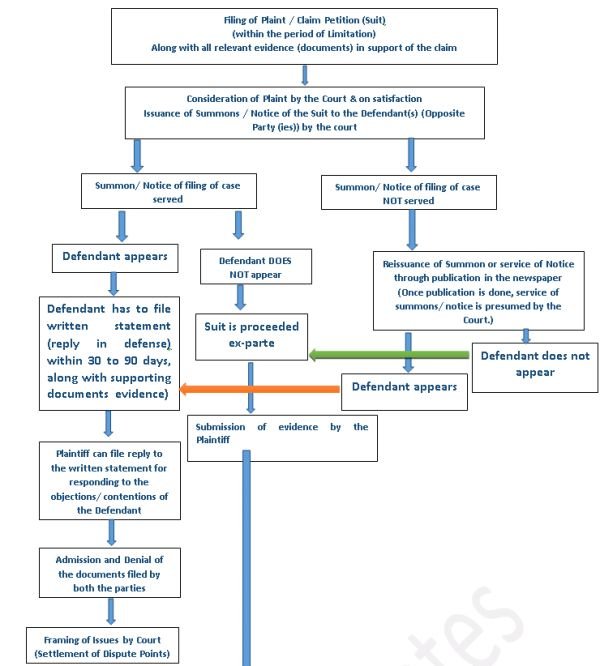
However not all civil cases follow these categories. Some cases, such as summary suits, have different procedures set out in the Code of Civil Procedure.
- The process of the trial of a civil case and its different stages is given in the Code of Civil Procedure 1908 (CPC).
- Court may grant time and adjourn hearings, with or without cost (Order XVII CPC).
- The decree and the orders of the Court can be executed through forcible measures by Court under Order XXI of CPC, in which the complete process of the execution has been given.
- The suit can be withdrawn or compromised at any point of time, under Order XXIII of CPC.
- Under Order XXVI, an application may be filed before the Court for appointment of a Commissioner for
- Examination of Witness;
- Local Investigations;
- Scientific Investigations;
- Performance of a ministerial act;
- Sale of movable or immovable party;
At the cost of the party seeking appointment.
The Local Commissioner, appointed by the Court, is considered to be an officer of the Court having all powers, which a Court Officer can exercise.
- Under Order XXXIX of CPC, the Court can pass TEMPORARY INJUNCTION AND INTERLOCUTORY ORDERS, for
- Preserving the subject-matter of the suit;
- Preventing the Defendant from removing or disposing of his property;
- Preventing irreparable loss or injury;
- Prevent continuation of the breach of any right.
* The flow chart may not be exactly as per rules and does not account for all eventualities.
Researcher and Writers: -
Eng. Devendra Chaudhary*, ACA Jayesh Sharma*, Advocate (Raj. High Court) Sandeep Nirwan**, Sc. Prakash Chand Sharma****
Designated Partners & Associate Techlam Legal Business (TLB) LLP
Mobile: +91 9116098980/9119112929 email: info@zumosun.com
DISCLAIMER:
While every care has been taken in the preparation of this information/report/flowchart/presentation/video to ensure its accuracy at the time of publication ZUMOSUN SOFT GROUP, Techlam Legal Business (TLB) LLP assumes no responsibility for any errors which despite all precautions, may be found herein. Neither this informations/report/flowchart/presentation/video nor the information contained herein constitutes a contract or will form the basis of a contract. The material contained in this document does not constitute/substitute professional advice that may be required before acting on any matter. Professional advice must be taken before acting. This information/report/flowchart/presentation/video is for general guidelines only.
*COPYRIGHT NOTICE: - © 2021, India. All Rights reserved with ZUMOSUN SOFT GROUP, Techlam Legal Business (TLB) LLP Branded by (“TheLegalCourt”) TM, and (“TheLegalbank”) R, B-4/193, Chitrakoot Scheme, Vaishali Nagar, Jaipur-302021
What You Receive & Core Benefits
Key statutory deliverables and strategic advantages guaranteed with this service activation.
Exclusive statutory rights and legal protection across all Indian jurisdictions
Official government acknowledgment receipt and permanent digital registration certificate
Deterrent against unauthorized infringement, imitation, and legal disputes
Invaluable institutional asset enhancing enterprise valuation and investor trust
Digital vault archiving with 24/7 lifetime access to all compliance records
Dedicated Practice Specialist guidance from filing to final regulatory grant
Step-by-Step Execution Process
Structured milestone progression ensuring zero friction and complete regulatory accuracy.
01
Discovery & Preliminary Assessment
Strategic feasibility analysis, availability check, and scope mapping.
02
Documentation & Architecture
Drafting statutory dossiers, legal vetting by certified advocates/CAs, and client verification.
03
Government Submission & ARN Generation
Priority filing with official government registries and instant tracking receipt issuance.
04
Statutory Monitoring & Certification Grant
Response to queries, publication follow-up, and final certificate issuance.
Eligibility Criteria & Documents Required
Clear compliance checklist for applicants and corporate entities prior to statutory submission.
Who is Eligible?
- Individuals, Proprietorships, Partnership Firms, and LLPs
- Private Limited, Public Limited, and One Person Companies (OPCs)
- DPIIT-recognized Startups and MSMEs (eligible for statutory fee concessions)
- Section 8 Non-Profit Companies, Trusts, and Registered Societies
- Foreign Applicants and Global Enterprises with registered address in India
Documents Required Checklist
- PAN Card & Aadhaar / Passport of Applicant or Authorized Signatory
- Certificate of Incorporation / Partnership Deed / LLP Agreement / Udyam Certificate
- Brand Identity / Logo in High-Resolution JPEG/PNG format (if applicable)
- Signed Power of Attorney / Authorization Mandate in favor of Practice Head
- Proof of Principal Place of Business (Utility Bill / Rent Agreement / GST Certificate)
- User Affidavit with Date of First Commercial Use (where prior use is claimed)
⚠️ Common Mistakes to Avoid & Filing Risks
Critical statutory pitfalls identified by our Senior Practitioners that frequently cause objections or rejection.
Filing Without Prior Regulatory Search
Applying without an authoritative conflict search leads to statutory objections and prolonged legal delays.
Selecting Generic or Descriptive Terms
Marks or names that directly describe the goods/services face immediate refusal under statutory provisions.
Incorrect Classification of Classes or Scope
Filing in the wrong statutory class leaves your core operations unprotected against competitors.
Missing Statutory Examination Deadlines
Failure to submit compliant legal responses within the stipulated 30-day window results in abandonment.
🏛️ E-E-A-T Regulatory Trust & Institutional Authority
Google E-E-A-T certified framework: Verified practitioner leadership, statutory accreditation, and audited quality standards.
E
15+ Years Active Experience
Over 15 years of continuous ground execution across High Courts, Registrar of Companies (ROC), CGPDTM Trademark Registry, and Central Ministries, with 10,000+ completed mandates.
E
Chartered & Bar-Council Expertise
Filings drafted and supervised by certified Chartered Accountants (ICAI), Company Secretaries (ICSI), Advocates (Bar Council of India), and registered Trademark Agents.
A
Statutory Authoritativeness
Direct integration with statutory portals (MCA21, IP India, GSTN). Recognized by Startup India and MSME regulatory frameworks under ISO 9001:2015 process standards.
T
100% Institutional Trust
Binding Non-Disclosure Agreements (NDA), 256-Bit SSL data encryption, statutory milestone tracking, and transparent GST tax invoices provided with zero hidden charges.

🏛️ MCA & ROC Liaison
📜 ISO 9001:2015
⚖️ Bar Council / ICAI
🇮🇳 Service Available Across India — Active Filing Desks
Pan-India jurisdictional presence: Active state, city, and locality filing desks across all major commercial and High Court clusters.
Delhi NCR
Active Desk
New Delhi / NCR
📍 Connaught Place, Nehru Place, Aerocity, Gurugram Cyber Hub, Noida Sec-62
🏛️ Delhi High Court, ROC Delhi, CGPDTM Dwarka
Activate at Delhi Desk →
Maharashtra
Active Desk
Mumbai & Pune
📍 BKC, Nariman Point, Andheri East, Vashi, Shivaji Nagar Pune, Hinjewadi
🏛️ Bombay High Court, ROC Mumbai, CGPDTM Antop Hill
Activate at Mumbai Desk →
Karnataka
Active Desk
Bengaluru Hub
📍 Koramangala, Indiranagar, Whitefield, Electronic City, MG Road
🏛️ Karnataka High Court, ROC Bengaluru
Activate at Bengaluru Desk →
Rajasthan
Active Desk
Jaipur & Jodhpur
📍 Mansarovar, C-Scheme, Vaishali Nagar, Sitapura, M.I. Road, Jodhpur Hub
🏛️ Rajasthan High Court, ROC Jaipur
Activate at Jaipur Desk →
Gujarat
Active Desk
Ahmedabad & Surat
📍 SG Highway, Prahlad Nagar, GIFT City Gandhinagar, Ring Road Surat
🏛️ Gujarat High Court, ROC Ahmedabad, CGPDTM Gota
Activate at Gujarat Desk →
Telangana
Active Desk
Hyderabad Hub
📍 HITEC City, Gachibowli, Madhapur, Banjara Hills, Jubilee Hills
🏛️ Telangana High Court, ROC Hyderabad
Activate at Hyderabad Desk →
Tamil Nadu
Active Desk
Chennai & Coimbatore
📍 T. Nagar, OMR IT Corridor, Guindy, Anna Nagar, RS Puram Coimbatore
🏛️ Madras High Court, ROC Chennai, CGPDTM Guindy
Activate at Chennai Desk →
Uttar Pradesh
Active Desk
Lucknow & Kanpur
📍 Gomti Nagar, Hazratganj, Civil Lines Kanpur, Noida Expressway
🏛️ Allahabad High Court (Lucknow Bench), ROC Kanpur
Activate at UP Desk →
West Bengal
Active Desk
Kolkata Hub
📍 Salt Lake Sector V, Park Street, New Town, BBD Bagh, Alipore
🏛️ Calcutta High Court, ROC Kolkata, CGPDTM Salt Lake
Activate at Kolkata Desk →
Frequently Asked Questions
Clear answers to common questions about activation, compliance, and deliverables.
Immediately upon order submission, our automated resource allocation engine assigns a dedicated Senior Specialist within 30 minutes. You will receive an onboarding confirmation and direct WhatsApp contact for real-time milestone tracking.
No. Zumosun adheres strictly to transparent pricing. All statutory fees, professional consultation expenses, and cloud filing charges are explicitly listed upfront without hidden charges.
Yes. Zumosun operates dedicated liaison desks across all Indian states and High Court jurisdictions (Delhi, Mumbai, Bengaluru, Jaipur, Ahmedabad, Hyderabad, Chennai, Kolkata, etc.). Your filing is handled by local jurisdiction specialists for seamless compliance.
Absolutely. Our modular architecture allows customized enterprise scoping, multi-entity configurations, or expedited turnaround SLAs. You can connect with our Senior Specialist via WhatsApp to tailor the exact scope.
Our certified practice heads actively monitor your filing lifecycle. If any clarification or discrepancy arises, our team drafts and files appropriate statutory responses promptly to ensure seamless resolution.