Ease of Civilization (EoC): Transforming Complexity into Simplicity
In today’s rapidly evolving world, civilizations, organizations, economies, and human systems are facing increasing complexity. Fragmented operations, disconnected systems, inaccessible resources, operational inefficiencies, governance challenges, and rising execution overload are creating friction across every level of society.
To address these challenges, ZUMOSUN is building the Ease of Civilization (EoC) Framework — a strategic transformation and optimization architecture focused on simplifying systems, improving accessibility, reducing friction, and enabling scalable transformation across civilization infrastructure.
EoC is not designed as abstract philosophy. It is designed as a practical transformation framework that combines:
- intelligence,
- operational systems,
- governance,
- AI,
- automation,
- ecosystem development,
- and scalable execution infrastructure.
The core mission of EoC is simple:
Transform Complexity into Simplicity.
The Transformation Architecture
The Ease of Civilization Framework operates within the larger transformation journey:
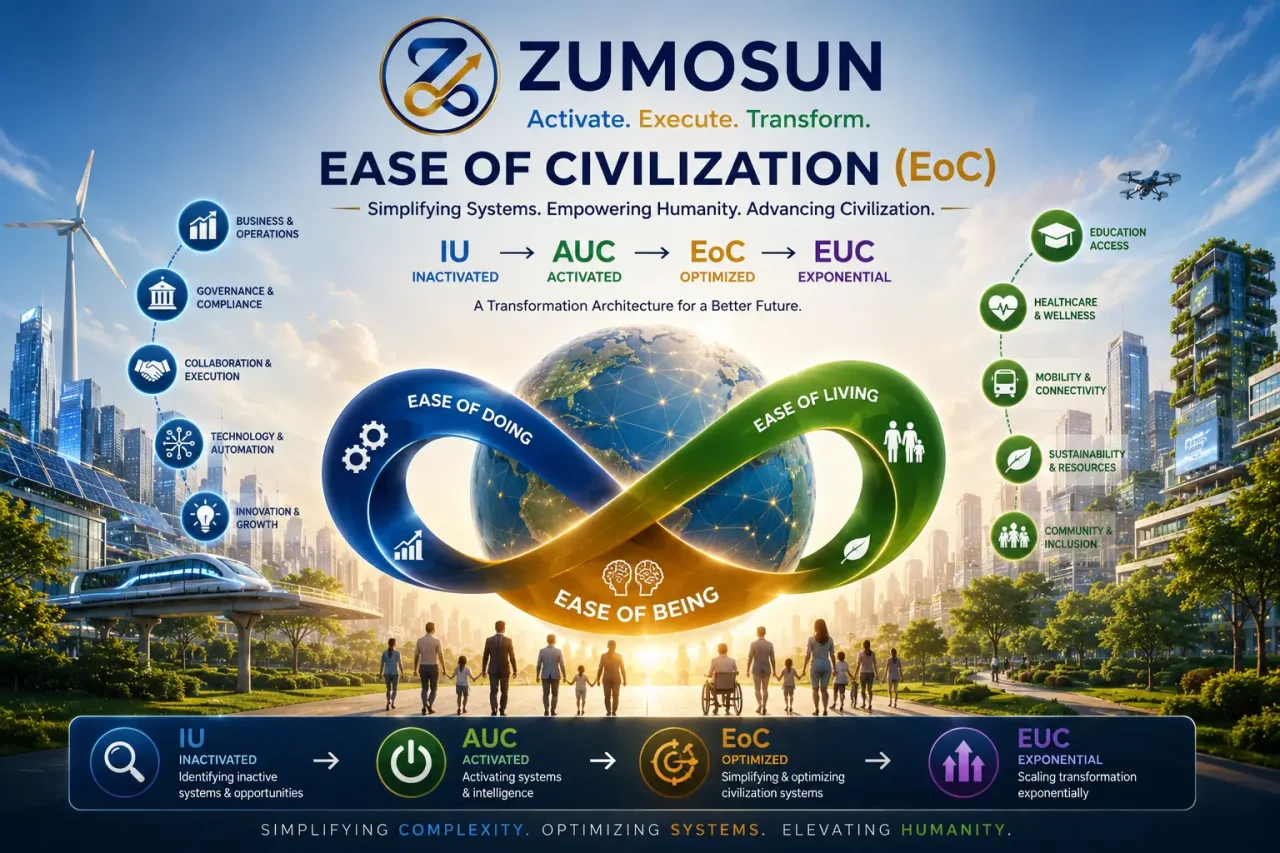
IU → AUC → EoC → EUC
This architecture represents a structured progression from inactive systems toward exponential civilization transformation.
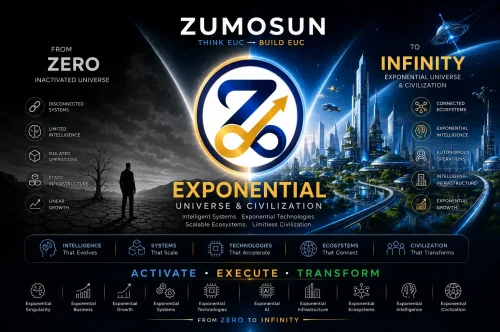
IU — Inactivated Universe
The inactive state where systems, resources, intelligence, and opportunities remain fragmented, disconnected, and underutilized.
AUC — Activated Universe & Civilization
The activation layer where systems, organizations, intelligence, and ecosystems become connected, operational, and scalable.
EoC — Ease of Civilization
The optimization layer focused on simplifying complexity, improving usability, reducing friction, and enhancing accessibility across civilization systems.
EUC — Exponential Universe & Civilization
The exponential layer where interconnected systems, intelligence, ecosystems, and transformation infrastructures scale continuously and exponentially.
Together, this framework creates a scalable transformation pathway for organizations, ecosystems, economies, and future civilization systems.
Why Ease of Civilization Matters
Modern civilization is increasingly driven by:
- data,
- technology,
- automation,
- governance,
- interconnected ecosystems,
- and digital infrastructure.
However, despite technological advancement, complexity continues to increase.
People struggle with:
- complex processes,
- fragmented systems,
- inaccessible opportunities,
- operational overload,
- governance inefficiencies,
- and disconnected human experiences.
EoC focuses on solving these challenges by reducing friction between:
- humans,
- organizations,
- systems,
- intelligence,
- ecosystems,
- and civilization infrastructure.
The objective is not only technological advancement — but intelligent simplification.
The Three Core Dimensions of EoC
1. Ease of Doing (EoD)
Ease of Doing focuses on simplifying:
- business,
- operations,
- execution,
- governance,
- compliance,
- collaboration,
- and organizational systems.
The goal is to improve productivity, scalability, operational efficiency, and transformation execution.
EoD Areas Include:
- Ease of Doing Business
- Ease of Execution
- Ease of Governance
- Ease of Compliance
- Ease of Scaling
- Ease of Collaboration
- Ease of Transactions
- Ease of Innovation
- Ease of Access to Opportunities
Transformation Infrastructure Includes:
- AI Agents
- Automation Systems
- SOP Infrastructure
- Business Transformation Systems
- Legal-Tech
- Finance-Tech
- Operational Intelligence
- Digital Infrastructure
EoD represents the operational and economic simplification layer of civilization transformation.
2. Ease of Living (EoL)
Ease of Living focuses on improving:
- accessibility,
- infrastructure,
- sustainability,
- connectivity,
- and quality of life systems.
The objective is to build human-centric ecosystems that simplify daily living experiences and improve access to essential resources and services.
EoL Areas Include:
- Ease of Education
- Ease of Healthcare
- Ease of Mobility
- Ease of Communication
- Ease of Housing
- Ease of Sustainability
- Ease of Resource Access
- Ease of Community Participation
Ecosystem Development Potential:
- Smart ecosystems
- Smart infrastructure
- Human-centric systems
- Digital accessibility infrastructure
- Resource optimization systems
- Connected service ecosystems
EoL represents societal and human accessibility optimization.
3. Ease of Being (EoB)
Ease of Being is the deepest layer of the framework.
It focuses on:
- intelligence,
- adaptability,
- learning,
- clarity,
- purpose alignment,
- and human capability activation.
EoB expands beyond traditional business transformation into:
- transformation science,
- intelligence systems,
- human optimization,
- and civilization intelligence infrastructure.
EoB Areas Include:
- Ease of Learning
- Ease of Thinking
- Ease of Understanding
- Ease of Decision Making
- Ease of Adaptation
- Ease of Human Potential Activation
- Ease of Mental Clarity
- Ease of Contribution
This dimension integrates:
- human intelligence,
- system intelligence,
- operational intelligence,
- and civilization optimization.
From Philosophy to Commercialization
One of the most important aspects of the EoC Framework is that it is designed for commercialization through real systems and measurable outcomes.
EoC is not intended to remain a theoretical philosophy.
It becomes commercially valuable when transformed into:
- operational systems,
- automation infrastructure,
- AI ecosystems,
- governance platforms,
- optimization frameworks,
- digital infrastructure,
- and scalable execution models.
Commercialization Opportunities Include:
- Consulting
- AI Infrastructure
- SaaS Platforms
- Digital Transformation
- Automation Systems
- Governance Infrastructure
- Ecosystem Platforms
- Operational Optimization Systems
- Transformation Intelligence Systems
The real commercial goal of EoC is to simplify complexity while improving efficiency, accessibility, scalability, and execution quality.
The Future of Civilization Infrastructure
The future will belong to systems that:
- reduce friction,
- simplify complexity,
- improve accessibility,
- optimize execution,
- activate intelligence,
- and scale transformation sustainably.
ZUMOSUN is building the Ease of Civilization Framework to contribute toward that future through interconnected transformation systems, operational intelligence, ecosystem development, and scalable civilization infrastructure.