
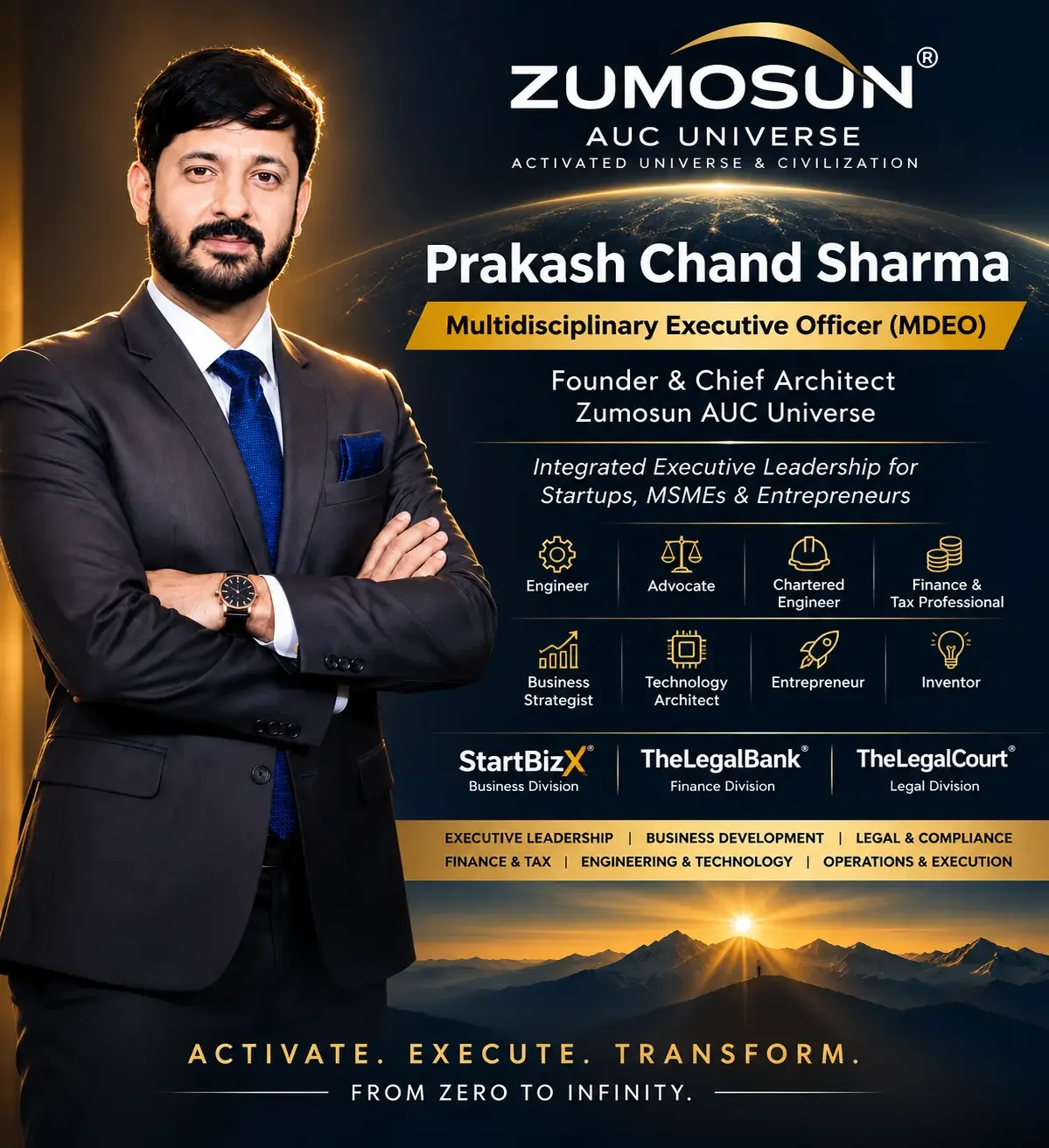
Prakash Chand Sharma – Multidisciplinary Executive Officer (MDEO): Integrated Executive Leadership for Startups, MSMEs & Entrepreneurs
Integrated Leadership for Engineering, Business, Legal, Finance, Technology, Management and Institutional Development.
In an increasingly interconnected business environment, organizations require more than individual professional expertise. They require integrated leadership capable of understanding multiple business disciplines, coordinating professional resources, making strategic decisions and converting opportunities into executable business systems.
Startups, Micro, Small and Medium Enterprises (MSMEs), entrepreneurs and growing organizations frequently face a common challenge: they need experienced executive leadership across business strategy, finance, taxation, legal affairs, engineering, technology, operations, marketing and organizational management, but hiring separate full-time executives for every function may not be financially practical.
A startup may require a Chief Executive Officer (CEO) to establish business direction, a Chief Operating Officer (COO) to manage operations, a financial executive to oversee financial planning, a technology leader to develop digital infrastructure and legal professionals to manage corporate governance and regulatory requirements.
Similarly, an MSME may require multidisciplinary executive capabilities to establish, manage, restructure, automate and expand its business.
The future requires a leadership approach that connects these disciplines through integrated thinking, strategic coordination and measurable execution.
Prakash Chand Sharma represents this multidisciplinary approach through the professional identity of a Multidisciplinary Executive Officer (MDEO).
An Engineer, Chartered Engineer, Advocate, Finance and Taxation Professional, Business Strategist, Technology Architect, Entrepreneur and Inventor, his professional approach combines engineering principles, legal understanding, financial analysis, business intelligence, technology architecture and management systems.
He is the Founder and Chief Architect of Zumosun AUC Universe (Activated Universe & Civilization), an initiative focused on developing integrated business ecosystems, resource activation frameworks, technology platforms and execution systems.
His professional philosophy is built around one principle:
Leadership should not operate through isolated departments. It should integrate knowledge, professionals, technology, finance and resources into a coordinated system that creates measurable business outcomes.
1. Who Is Prakash Chand Sharma?
Prakash Chand Sharma is an Indian multidisciplinary professional, entrepreneur, researcher and executive leadership professional whose work spans engineering, business development, law, finance, taxation, technology, management and institutional development.
His educational and professional foundation includes:
-
B.Tech. – Engineering education and technical problem-solving.
-
LL.B. – Legal education and the foundation for professional legal practice.
-
Chartered Engineer – Professional engineering recognition.
-
Advocate – Legal practice, research, drafting, litigation and legal documentation.
-
Finance and Taxation Experience – Professional experience in financial, accounting, taxation and business compliance matters, including CA practice experience.
-
Business Development – Business opportunity development, enterprise architecture, commercial strategy and execution-oriented growth systems.
-
Technology Architecture – Research and development of integrated platforms, operating frameworks and intelligent execution systems.
-
Entrepreneurship and Innovation – Business development, intellectual property, research and technology commercialization.
-
Management and Institutional Development – Organizational systems, project management, resource coordination and institutional growth.
His professional journey reflects an important principle: business problems rarely belong to a single discipline.
A manufacturing project, for example, may require engineering feasibility, land and property assessment, company registration, financial modelling, taxation, government approvals, commercial agreements, technology integration and operational management.
Similarly, a startup may require business strategy, legal structuring, financial planning, product development, technology infrastructure, marketing and organizational execution.
His multidisciplinary approach focuses on understanding these relationships and organizing them into a coordinated leadership framework.
For engineering-related professional information, readers can refer to The Institution of Engineers (India).
For company establishment and corporate regulatory information, readers can consult the Ministry of Corporate Affairs – Government of India.
2. What Is a Multidisciplinary Executive Officer (MDEO)?
A Multidisciplinary Executive Officer (MDEO) is a proposed professional leadership designation for an executive who integrates knowledge, capabilities and practical experience across multiple business disciplines to support organizational strategy, management, coordination and execution.
Traditional executive positions generally focus on specific organizational functions. For example:
-
CEO – Chief Executive Officer.
-
COO – Chief Operating Officer.
-
CFO – Chief Financial Officer.
-
CTO – Chief Technology Officer.
-
CBO – Chief Business Officer.
-
CMO – Chief Marketing Officer.
-
CHRO – Chief Human Resources Officer.
Each position serves an important purpose within an organization.
However, smaller businesses and growing enterprises may need coordination across all these functions without immediately establishing a complete executive management structure.
An MDEO approaches business leadership from a multidisciplinary perspective.
The objective is to understand the relationships between different business functions, coordinate the appropriate specialists, support executive decision-making and ensure that organizational strategies translate into measurable execution.
For example:
-
A legal decision may directly affect financial planning.
-
A financial decision may affect business expansion.
-
A technology decision may affect operational efficiency.
-
An engineering decision may affect project feasibility.
-
An operational decision may affect customer experience.
-
A business development decision may affect capital requirements.
-
A governance decision may affect organizational sustainability.
A multidisciplinary executive understands these interdependencies and helps management make coordinated decisions.
MDEO is used here as a descriptive professional leadership designation, not as a separate statutory corporate office or regulated professional qualification under Indian law.
MDEO vs. MSEO – Understanding the Two Designations
Two related designations can describe multidisciplinary executive capabilities.
A. MDEO – Multidisciplinary Executive Officer
Focuses on executive leadership, multidisciplinary decision-making, organizational management, strategic coordination and integrated execution.
B. MSEO – Multiskills Executive Officer
Focuses on the possession and application of multiple professional skills and capabilities across different business functions.
MDEO is the recommended primary professional designation for Prakash Chand Sharma because it communicates multidisciplinary executive leadership rather than simply possessing multiple skills.
3. Why Startups, MSMEs and Entrepreneurs Need an MDEO
Starting and managing a business requires coordinated decisions across multiple disciplines.
However, many entrepreneurs and business owners operate with limited financial resources, small teams and evolving organizational structures.
This creates several challenges.
A. Fragmented Professional Services
Businesses often appoint different consultants for legal, finance, taxation, technology, engineering and management functions.
Although specialist expertise is important, disconnected professional advice can create coordination problems, repeated communication and execution delays.
A multidisciplinary executive can help coordinate these professional functions under a unified business strategy.
B. High Cost of Executive Recruitment
Hiring a complete C-suite management team may not be financially practical for an early-stage organization.
A startup may not immediately require separate full-time CEOs, CFOs, CTOs, COOs and other executive officers.
A fractional or project-based MDEO engagement can provide access to multidisciplinary executive capabilities without immediately creating the cost structure of a large management team.
C. Lack of Strategic Direction
Many entrepreneurs understand their products and markets but require assistance with:
-
Business model development.
-
Organizational structuring.
-
Financial planning.
-
Legal and regulatory requirements.
-
Technology development.
-
Operational systems.
-
Business growth strategies.
-
Execution planning.
An MDEO can help convert business ideas into structured plans and execution roadmaps.
D. Difficulty Integrating Multiple Departments
Legal, financial, technical, operational and commercial decisions are interconnected.
Multidisciplinary leadership helps establish coordination between these functions and reduce organizational fragmentation.
E. Execution Gaps
Business success requires more than recommendations.
It requires responsibility, timelines, resources, professional coordination, monitoring and measurable deliverables.
An MDEO can help bridge the gap between strategy and implementation.
F. Founder Dependency
In many startups and family-owned MSMEs, founders personally manage almost every business activity.
This creates operational dependency and limits the ability to scale.
An MDEO can help establish organizational responsibilities, management systems, workflows and professional coordination to reduce excessive dependence on individual founders.
For business establishment, corporate development and business growth solutions, entrepreneurs can explore StartBizX – Business Division.
For India's startup ecosystem and entrepreneurship initiatives, readers can refer to the Startup India Initiative.
For official MSME enterprise registration and related information, refer to the Udyam Registration Portal.
4. The Seven Dimensions of Prakash Chand Sharma's MDEO Professional Approach
The multidisciplinary executive approach integrates seven major dimensions.
A. Strategic and Chief Executive Leadership
Strategic leadership provides direction to an organization.
An MDEO can support founders and management teams in:
-
Business vision and mission development.
-
Strategic business planning.
-
Business model development.
-
Organizational structuring.
-
Executive decision support.
-
Business performance monitoring.
-
Growth and expansion planning.
-
Institutional development.
-
Strategic resource allocation.
-
Long-term business sustainability.
The objective is to establish a clear relationship between organizational vision, available resources, business strategy and execution.
B. Business Development and Commercial Leadership
Business development involves identifying opportunities, understanding markets, creating business models, developing strategic relationships and building commercial value.
His professional approach includes:
-
Business opportunity identification.
-
Business model development.
-
Startup and enterprise development.
-
Corporate structuring and business establishment.
-
B2B, B2C, D2C and institutional business models.
-
Business process development.
-
Revenue and growth architecture.
-
Strategic partnerships and collaborations.
-
Market expansion and commercialization.
-
Business operations and execution systems.
A business idea becomes commercially meaningful when the product, market, resources, financial model, operational capabilities and execution strategy work together.
For business establishment, corporate development and business solutions, explore StartBizX – Business Division.
C. Engineering and Technology Leadership
Engineering develops the ability to understand complex systems, analyse problems, identify constraints, design solutions and improve performance.
Technology leadership connects engineering knowledge with digital infrastructure, software systems, automation and intelligent business operations.
His professional approach includes:
-
Technical feasibility and assessment.
-
Engineering project planning.
-
Technology architecture.
-
Digital transformation.
-
Website and platform development strategy.
-
AI and automation integration.
-
Software and systems architecture.
-
Data and intelligence architecture.
-
Technology resource coordination.
-
Scalable digital infrastructure.
The objective is to integrate appropriate engineering and technology capabilities into organizational development.
For understanding the broader technology and resource activation ecosystem, explore Zumosun AUC Universe.
D. Legal, Corporate and Governance Leadership
Every business operates within a legal and regulatory environment.
Company formation, commercial agreements, property transactions, intellectual property, employment relationships, taxation and regulatory approvals require appropriate legal understanding.
As an Advocate, Prakash Chand Sharma's professional work includes legal research, drafting, litigation, legal documentation and business-related legal matters.
His areas of professional focus include:
-
Corporate and commercial law.
-
Civil and criminal litigation.
-
Property and real estate law.
-
Contract and agreement drafting.
-
Intellectual property rights.
-
Legal due diligence.
-
Business regulatory compliance.
-
Corporate documentation.
-
Legal risk identification and management.
-
Governance and legal process coordination.
Legal Engineering connects legal knowledge with business processes, technical systems, operational requirements and structured documentation.
For business-related legal services and legal resources, explore TheLegalCourt – Legal Division.
For corporate registration and statutory company information, readers can refer to the Ministry of Corporate Affairs.
E. Finance and Taxation Leadership
A business opportunity must be financially viable to become sustainable.
Financial planning, capital allocation, project costing, taxation, investment requirements and cash-flow management are essential components of business development.
His finance and taxation experience contributes to a multidisciplinary perspective on:
-
Financial planning and analysis.
-
Accounting and financial documentation.
-
Direct and indirect taxation.
-
GST and business compliance.
-
Corporate financial structures.
-
Project reports and financial modelling.
-
Project finance and funding requirements.
-
Investment and capital planning.
-
Business feasibility and risk assessment.
-
Financial resource management.
-
Budgeting and cost management.
Finance and taxation are relevant throughout the business lifecycle, from business establishment and investment to operations, expansion and restructuring.
For finance, taxation and compliance-related information and solutions, explore TheLegalBank – Finance Division.
For official indirect taxation information, readers can refer to the Goods and Services Tax Portal.
F. Operations and Project Leadership
Business strategy requires an organizational structure capable of implementing decisions and delivering results.
An MDEO can support operational and project management through:
-
Project planning and implementation.
-
Business process development.
-
Resource allocation.
-
Vendor and professional coordination.
-
Operational monitoring.
-
Performance measurement.
-
Risk management.
-
Process improvement.
-
Departmental coordination.
-
Project execution monitoring.
The objective is to establish systems that convert management decisions into practical operational outcomes.
G. Innovation, Research and Intellectual Property Leadership
Innovation creates new products, technologies, services, intellectual property and commercial opportunities.
His innovation-oriented professional approach includes:
-
Innovation strategy.
-
Research and development coordination.
-
Intellectual property identification.
-
Patent and trademark strategy.
-
Product development planning.
-
Technology commercialization.
-
New business opportunity development.
-
Knowledge and research management.
-
Innovation-based business models.
For official information on intellectual property protection in India, readers can refer to Intellectual Property India.
5. Executive Functions an MDEO Can Support
A multidisciplinary executive may perform or support functions commonly associated with several executive positions, depending on the engagement scope, professional competence and formal authority.
| Executive Function | Primary Responsibility |
|---|---|
| CEO | Business direction and organizational leadership |
| COO | Operations and execution |
| CBO | Business development and commercial growth |
| CFO | Financial strategy and financial governance |
| CTO | Technology strategy and infrastructure |
| CLO | Legal strategy and governance coordination |
| CMO | Marketing and market development |
| CHRO | Human capital and organizational development |
| CSO | Corporate strategy and growth |
| Project Director | Project planning and implementation |
An MDEO does not automatically hold all these executive offices.
The purpose is to integrate, coordinate and support these business functions through multidisciplinary executive capabilities.
Formal corporate appointments, delegated authority and statutory responsibilities must be separately established in accordance with applicable laws and organizational requirements.
6. Professional Engagement Models – How Businesses Can Work with an MDEO
Different organizations require different levels of executive leadership depending on their stage of development, financial capacity and operational complexity.
Prakash Chand Sharma's MDEO positioning can support several engagement models.
A. Fractional MDEO
Part-time executive leadership for startups and MSMEs that need multidisciplinary management without appointing a full-time executive.
B. Virtual MDEO
Remote executive coordination, strategic planning, business reviews and execution monitoring.
C. Retainer-Based MDEO
A monthly professional engagement for ongoing strategic, operational and multidisciplinary executive support.
D. Project-Based MDEO
Executive leadership for a defined business project, such as manufacturing setup, technology implementation, institutional development or business expansion.
E. Interim Executive
Temporary executive leadership during organizational transitions, management restructuring or leadership vacancies, subject to formal appointment where required.
F. Strategic Business Partner
A long-term business relationship involving strategic planning, resource activation, commercial development and growth execution.
G. Co-Founder Partnership
A potential long-term venture-building relationship involving mutually agreed responsibilities, ownership, investment, intellectual property rights, decision-making authority and risk allocation.
A co-founder relationship should be established through appropriate legal documentation and cannot be assumed merely from an advisory or executive engagement.
7. Who Needs a Multidisciplinary Executive Officer?
The MDEO model can benefit different categories of organizations.
Startups
-
First-time founders.
-
Technology startups.
-
Product development companies.
-
Innovation-driven ventures.
-
Early-stage businesses.
-
Fundraising and expansion-stage startups.
-
Startups establishing their first management structure.
MSMEs
-
Manufacturing businesses.
-
Trading enterprises.
-
Service companies.
-
Construction businesses.
-
Engineering enterprises.
-
Family-owned businesses.
-
Export-oriented organizations.
-
Businesses planning operational expansion.
Entrepreneurs
-
Individual business owners.
-
New business promoters.
-
Entrepreneurs entering new industries.
-
Professionals transitioning into entrepreneurship.
-
Business owners seeking structured expansion.
-
Entrepreneurs developing multiple ventures.
Growing Companies
-
Companies establishing new departments.
-
Organizations undergoing restructuring.
-
Businesses implementing digital transformation.
-
Companies developing new products.
-
Organizations expanding into new markets.
-
Businesses requiring multidisciplinary executive coordination.
Institutional and Project Developers
-
Infrastructure developers.
-
Industrial project promoters.
-
Educational institutions.
-
Healthcare project developers.
-
Social development organizations.
-
Technology and innovation institutions.
-
Large integrated development projects.
8. The MDEO Execution Framework – From Business Idea to Institutional Growth
The MDEO approach follows an integrated business development lifecycle.
Stage 1: Understand – Business and Organizational Assessment
Understand the founder's vision, business model, products, services, market, organizational structure and current challenges.
Stage 2: Analyze – Multidisciplinary Feasibility
Assess the existing business structure, professional resources, financial position, technology, legal requirements and operational capabilities.
Stage 3: Architect – Develop the Business System
Develop the organizational roadmap, business strategy, functional responsibilities, financial priorities and execution framework.
Stage 4: Activate – Connect Required Resources
Identify and coordinate the required people, professionals, capital, technology, infrastructure, partnerships and market opportunities.
Stage 5: Execute – Convert Strategy into Action
Convert plans into tasks, timelines, milestones, responsibilities and measurable deliverables.
Stage 6: Measure – Monitor Performance
Review business performance, operational efficiency, financial progress, risks and growth indicators.
Stage 7: Scale – Develop Institutional Capacity
Build sustainable organizational systems, management capabilities, technology infrastructure and expansion strategies.
MDEO Execution Cycle:
Understand → Analyze → Architect → Activate → Execute → Measure → Scale
The objective is to transform fragmented business resources into a coordinated and executable organizational system.
9. The ZUMOSUN Connection – Leadership Meets Resource Activation
Prakash Chand Sharma's multidisciplinary executive philosophy is connected with the larger vision of Zumosun AUC Universe.
ZUMOSUN is developing an integrated Global Resource Activation and Execution ecosystem designed to connect people, businesses, knowledge, technology, opportunities and capital.
Its philosophy is that resources should not remain isolated or underutilized. They should be identified, connected, activated, executed and scaled.
The MDEO professional model applies this resource-centric approach to organizational leadership.
ZUMOSUN Group – The Parent Ecosystem
ZUMOSUN AUC Universe represents the broader ecosystem and its vision of integrated business development, technology, engineering, resource activation and institutional development.
StartBizX – Business Division
StartBizX – Business Setup and Business Solutions focuses on business establishment, startup development, corporate structuring and business growth solutions.
TheLegalBank – Finance Division
TheLegalBank – Finance, Taxation and Compliance represents the finance division, covering financial, taxation and compliance-related information and solutions.
TheLegalCourt – Legal Division
TheLegalCourt – Legal Services and Legal Awareness represents the legal division, focusing on legal information, legal awareness, legal services and professional resources.
Z-ROS – Zumosun Resource Operating System
Z-ROS is an important technology initiative within the Zumosun ecosystem.
It is designed to organize, manage, connect, discover, activate and execute resources through a unified operating architecture.
Its broader architecture includes:
-
Universal Entity Schema (UES).
-
Resource Intelligence Graph (RIG).
-
Resource lifecycle management.
-
AI agents and intelligent automation.
-
Resource execution metrics.
-
Business and institutional workflows.
-
Integrated resource intelligence.
GRE – Global Resource Engine
The Global Resource Activation and Execution Engine is designed to support resource discovery, intelligence, connection, activation, utilization, monetization and execution.
Its resource lifecycle is:
Create → Activate → Connect → Discover → Utilize → Monetize → Automate → Compound → EUC
These initiatives reflect the broader vision of transforming disconnected resources into structured, productive and scalable assets.
Explore Zumosun AUC Universe to understand the wider ecosystem.
10. Leadership Assets OS – Organizing Leadership as a Strategic Resource
Leadership is not merely a designation or organizational position. It is a resource that creates direction, activates capabilities, coordinates people and produces measurable outcomes.
The proposed ZUMOSUN Leadership Assets OS™ is designed around the identification, documentation, development, activation, management and measurement of leadership capabilities.
Its proposed modules include:
-
Leadership Identity and Profile.
-
Leadership Qualification and Credentials.
-
Leadership Skills and Competency.
-
Leadership Experience and Achievement.
-
Leadership Vision and Mission.
-
Leadership Roles and Responsibilities.
-
Leadership Authority and Decision-Making.
-
Leadership Strategy and Planning.
-
Leadership Execution and Performance.
-
Leadership Resource Activation.
-
Leadership Team and Collaboration.
-
Leadership Communication.
-
Leadership Innovation and Research.
-
Leadership Governance and Ethics.
-
Leadership Risk and Accountability.
-
Leadership Intelligence and Analytics.
-
Leadership Development and Training.
-
Leadership Succession and Continuity.
-
Leadership Reputation and Influence.
-
Leadership Exponential Growth.
Within this framework, multidisciplinary executive capabilities can be identified, classified, measured and connected with organizational requirements.
One Leadership Asset = One Identifiable, Measurable, Activatable and Developable Resource.
11. Trust, Accountability and Professional Integrity
The title of an executive alone does not establish trust.
Trust must be developed through professional conduct, transparency, competence, accountability, confidentiality and measurable performance.
A credible multidisciplinary executive should operate on the following principles:
-
Professional integrity.
-
Transparent communication.
-
Clearly defined responsibilities.
-
Documented decision-making.
-
Confidentiality and data protection.
-
Conflict-of-interest disclosure.
-
Measurable deliverables.
-
Financial and operational accountability.
-
Respect for professional boundaries.
-
Long-term organizational value creation.
For companies, directors' statutory duties are governed by applicable corporate law. Section 166 of the Companies Act, 2013, provides an important reference concerning directors' duties, including good faith, reasonable care, skill, diligence and independent judgment.
Readers can refer to the Companies Act, 2013 – India Code for the statutory framework.
The MDEO engagement model should be built on documented responsibilities, transparent commercial terms, professional accountability and clearly defined decision-making authority.
12. Why the Future Needs Multidisciplinary Executive Leadership
The business environment is becoming increasingly interconnected.
Artificial intelligence, automation, digital platforms, regulatory developments, global markets, financial complexity and changing customer expectations are transforming how organizations operate.
Businesses increasingly need leaders who can understand the relationships between multiple disciplines.
A technology decision cannot always be separated from financial feasibility.
A financial decision cannot always be separated from legal compliance.
A business expansion decision cannot always be separated from operational capacity.
A strategic decision cannot create value without execution.
This creates an opportunity for multidisciplinary executive leadership to become an important organizational capability.
For startups and MSMEs, an MDEO engagement can offer a structured way to access integrated executive thinking and coordinated execution while retaining specialist professionals for their respective responsibilities.
Artificial intelligence will further increase the importance of multidisciplinary leadership.
Future executive systems will increasingly combine:
-
Human leadership and professional judgment.
-
Artificial intelligence and autonomous agents.
-
Financial and commercial intelligence.
-
Legal and regulatory understanding.
-
Engineering and technology architecture.
-
Resource intelligence and execution systems.
-
Institutional governance and accountability.
The objective is to develop organizations that are not only digitally enabled but also professionally managed, resource-efficient and capable of sustainable growth.
For information about entrepreneurship and innovation in India, readers can explore the Startup India Initiative.
13. Professional Values and Working Principles
The multidisciplinary executive philosophy rests on several important principles.
1. Knowledge Integration: Understand how engineering, business, law, finance and technology connect rather than treating every problem in isolation.
2. Evidence-Based Analysis: Build decisions on facts, documentation, technical information, financial data and reliable research.
3. Systematic Thinking: Identify the underlying business system, not merely the visible problem.
4. Practical Execution: Convert ideas, strategies and plans into actionable development processes.
5. Resource Optimization: Identify and utilize available resources effectively.
6. Technological Advancement: Apply appropriate technology and artificial intelligence to improve productivity and execution.
7. Professional Ethics: Respect professional standards, legal obligations, accountability and the limits of individual competence.
8. Continuous Innovation: Keep researching and developing as technologies, markets, laws and business environments evolve.
These principles establish the foundation for responsible, integrated and execution-oriented leadership.
14. The Long-Term Vision – From Business Leadership to Exponential Universe & Civilization
The long-term ambition behind Prakash Chand Sharma's work extends beyond conventional business management.
Through Zumosun AUC Universe, the vision is to develop integrated platforms, institutions, operating systems and resource architectures that connect people, businesses, technologies, knowledge and opportunities.
The broader vision involves:
-
Individuals discovering and activating opportunities.
-
Businesses identifying and utilizing resources.
-
Institutions integrating knowledge and capabilities.
-
Technologies automating operational processes.
-
Engineering resources connecting across industries.
-
Innovation converting into productive assets.
-
Intelligent systems supporting business execution.
-
Resources generating sustainable and scalable value.
The ultimate destination is EUC – Exponential Universe & Civilization.
The broader development philosophy is:
Resource → Activation → Asset → Execution → Value → Revenue → Growth → Exponential Universe & Civilization (EUC)
This represents the long-term vision of developing interconnected systems that support the productive utilization and evolution of resources.
15. Connect with Prakash Chand Sharma – Multidisciplinary Executive Officer (MDEO)
Prakash Chand Sharma welcomes professional discussions and potential engagements with:
-
Startup founders seeking a strategic executive partner.
-
MSME owners seeking multidisciplinary business leadership.
-
Entrepreneurs planning to establish new ventures.
-
Business promoters developing new projects.
-
Growing organizations seeking executive coordination.
-
Companies requiring project-based strategic leadership.
-
Founders exploring potential co-founder partnerships.
-
Institutions developing integrated projects and operational systems.
Potential engagements can be discussed through clearly defined scopes, responsibilities, professional boundaries, commercial terms and mutually agreed performance expectations.
Professional Identity
Prakash Chand Sharma
Multidisciplinary Executive Officer (MDEO)
Founder & Chief Architect – Zumosun AUC Universe
Engineer | Advocate | Chartered Engineer | Finance & Tax Professional | Business Strategist | Technology Architect | Entrepreneur | Inventor
Core Proposition:
One Multidisciplinary Executive. Multiple Business Disciplines. Integrated Leadership. Measurable Execution.
Activate. Execute. Transform.
From Zero to Infinity.
Frequently Asked Questions (FAQs)
1. Who is Prakash Chand Sharma?
Prakash Chand Sharma is an engineer, Chartered Engineer, advocate and multidisciplinary business professional. He is the Founder and Chief Architect of Zumosun AUC Universe and positions himself as a Multidisciplinary Executive Officer (MDEO).
2. What is a Multidisciplinary Executive Officer (MDEO)?
An MDEO is a proposed professional designation for an executive who integrates capabilities across multiple business disciplines, including strategy, engineering, legal, finance, technology, operations and business development.
3. How can an MDEO help a startup?
An MDEO can help a startup develop business strategy, establish organizational systems, coordinate professional resources, manage projects, improve execution and plan business growth.
4. Can an MDEO work as a fractional CEO?
An MDEO may undertake a fractional CEO engagement where the organization formally defines the responsibilities, authority, scope and appointment terms. The MDEO designation alone does not confer CEO authority.
5. What is the difference between an MDEO and a traditional CEO?
A traditional CEO is responsible for the overall management and leadership of an organization. An MDEO emphasizes integrated executive capabilities across multiple disciplines. An individual may serve in both capacities if appropriately appointed and authorized.
6. Can an MDEO become a startup co-founder?
Yes. An MDEO may enter a co-founder relationship through a mutually agreed venture-building arrangement covering equity, responsibilities, intellectual property, governance and other contractual terms.
7. Can MSMEs engage an MDEO without hiring a full-time executive?
Yes. Depending on business requirements, an MDEO can work through fractional, virtual, monthly retainer, project-based or other agreed engagement models.
8. What makes Prakash Chand Sharma's MDEO positioning distinctive?
His professional foundation combines engineering, legal practice, finance and taxation experience, business development, technology architecture and organizational development, creating an integrated approach to business leadership.
9. Does an MDEO replace Chartered Accountants, Company Secretaries or other specialists?
No. An MDEO coordinates multidisciplinary business functions while specialist and regulated professional work remains with appropriately qualified and authorized professionals.
10. How can entrepreneurs explore an MDEO engagement?
Entrepreneurs, founders and MSME owners can connect through the ZUMOSUN ecosystem to discuss their business requirements, leadership needs and potential engagement structures.
Conclusion – Leadership That Connects Multiple Disciplines
The future of business leadership will increasingly depend on the ability to connect knowledge, professionals, technology, finance, legal systems and operational resources.
Startups, MSMEs and entrepreneurs need more than isolated professional advice. They need coordinated thinking, strategic direction, accountable execution and sustainable organizational development.
The Multidisciplinary Executive Officer (MDEO) represents a professional approach to meeting this need.
Through his multidisciplinary professional foundation and the broader vision of Zumosun AUC Universe, Prakash Chand Sharma aims to contribute to building businesses and institutions that are professionally structured, legally informed, financially conscious, technologically enabled and execution-oriented.
Because business growth is not created by one discipline alone. It is created when multiple disciplines work together under effective leadership.
Engineer Opportunities. Integrate Disciplines. Lead Execution. Build Institutions.
About Prakash Chand Sharma
Prakash Chand Sharma is an Indian Engineer, Chartered Engineer, Advocate, entrepreneur and multidisciplinary researcher. He holds a B.Tech. and LL.B. and has professional experience spanning engineering, legal practice, finance, taxation, technology, business development and innovation.
He is the Founder and Chief Architect of Zumosun AUC Universe, where his work focuses on integrated resource systems, technology architecture, AI-enabled execution, business development and institutional development.
Professional Designation: Multidisciplinary Executive Officer (MDEO)
Connect With Prakash Chand Sharma
Facebook- https://www.facebook.com/er.adv.ca.prakash.chandsharma.35/
Linkedin - https://www.linkedin.com/in/eng-adv-cao-prakash-chand-sharma-26586143/
Instagram - https://www.instagram.com/ad_eng_cao_prakashsharma?dlrf=aGN3aW9yY3JucGRk
X- https://x.com/prakash69sharma
Organization: Zumosun EUC Universe
Official Platforms:
Professional and educational information is presented for general informational purposes. Multidisciplinary Executive Officer is used as a descriptive professional leadership designation and does not represent a separate statutory corporate office or regulated professional qualification. Professional engineering, legal, financial and taxation activities remain subject to applicable qualifications, laws, regulations and professional conduct requirements.
Related Solutions & Execution Services
Activate verified corporate, technology, and engineering solutions backed by Zumosun specialists.