
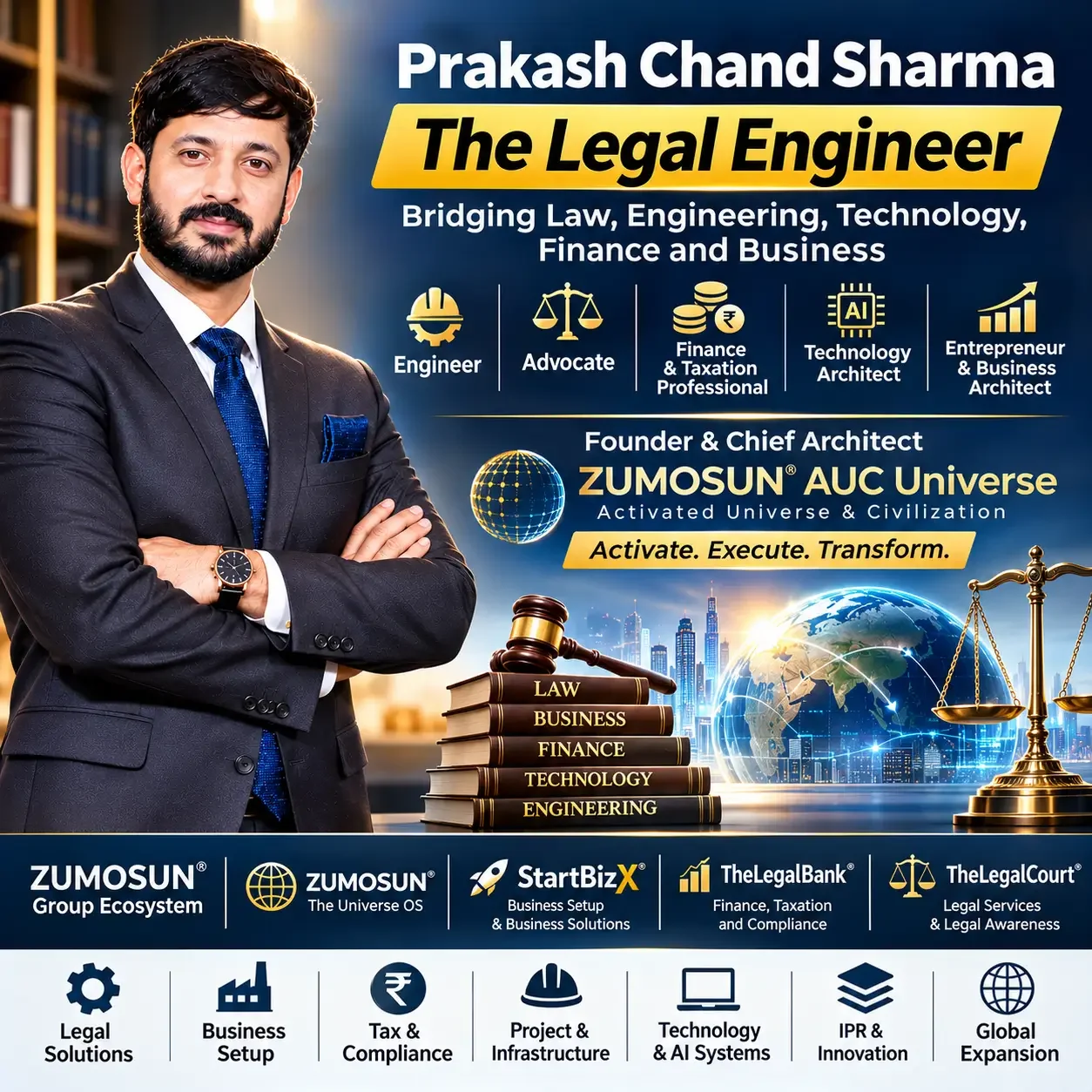
Prakash Chand Sharma – The Legal Engineer: Bridging Law, Engineering, Technology, Finance and Business
A multidisciplinary professional vision for the next generation of legal and business problem-solving.
In a world where legal challenges increasingly intersect with technology, finance, engineering, taxation and business operations, conventional professional boundaries are becoming less sufficient to address complex problems.
The future requires professionals who can understand not only the law but also the systems, structures, technologies, financial models and operational requirements surrounding it.
Prakash Chand Sharma represents this multidisciplinary approach through the professional identity of a Legal Engineer.
An Engineer, Advocate, Finance and Taxation Professional, Technology Architect and Entrepreneur, his professional approach brings together different disciplines to examine complex problems through structured thinking, legal reasoning, technical understanding and execution-oriented solutions.
He is the Founder and Chief Architect of Zumosun AUC Universe, an initiative focused on developing integrated systems connecting resources, intelligence, technology and execution.
1. Who Is Prakash Chand Sharma?
Prakash Chand Sharma is an Indian multidisciplinary professional, entrepreneur, researcher and legal practitioner whose work spans engineering, law, finance, taxation, technology and business development.
His educational and professional foundation includes:
-
B.Tech. – Engineering education and technical problem-solving.
-
LL.B. – Legal education and the foundation for professional legal practice.
-
Advocate – Legal practice, research, drafting and litigation.
-
Finance and Taxation Experience – Professional exposure to financial, accounting, taxation and business compliance matters.
-
Technology and Business Architecture – Research and development of integrated technology platforms, operating frameworks and execution systems.
His professional journey reflects an important principle: complex problems rarely belong to a single discipline.
His work connects professional knowledge with practical applications in legal systems, business structures, financial processes and technology development.
For the statutory framework governing the legal profession in India, readers can refer to the Advocates Act, 1961 – Official India Code.
2. What Is a Legal Engineer?
A Legal Engineer is a multidisciplinary professional approach that combines legal knowledge with engineering principles, analytical methods, technology and structured problem-solving.
Traditional legal practice focuses on interpreting laws, advising clients, drafting documents and representing parties before legal authorities.
Engineering focuses on understanding systems, identifying failures, analysing structures, developing solutions and improving performance.
Legal Engineering brings these approaches together.
It considers a legal problem not merely as a dispute or statutory question but as a system involving:
-
Facts and evidence.
-
Applicable laws and regulations.
-
Rights, obligations and liabilities.
-
Technical and operational requirements.
-
Financial implications.
-
Documentation and compliance.
-
Risk identification and mitigation.
-
Strategy, implementation and outcomes.
For example, a business dispute may involve company law, contractual obligations, financial records, taxation, technical evidence, ownership structures and regulatory compliance.
A multidisciplinary approach helps identify the relationships between these elements and organise them into a structured problem-solving process.
Legal Engineering is a descriptive multidisciplinary professional identity and approach, not a separate statutory legal qualification or designation under Indian law.
3. The Five Dimensions of His Professional Approach
A. Engineering – The Foundation of Structured Thinking
Engineering develops the ability to understand complex systems, analyse problems, identify constraints and design practical solutions.
This approach can also be applied to legal processes, business structures, technology platforms and institutional development.
The engineering mindset focuses on:
-
Problem identification and analysis.
-
Logical and systematic reasoning.
-
Structural and process design.
-
Risk and failure analysis.
-
Efficiency and optimisation.
-
Practical implementation.
B. Advocacy – The Foundation of Legal Reasoning
Legal practice requires an understanding of legislation, judicial interpretation, procedural requirements, evidence and legal remedies.
As an Advocate, Prakash Chand Sharma's professional work includes legal research, drafting, litigation preparation and legal problem analysis.
His areas of professional focus include civil litigation, criminal law, bail matters, property law, corporate and business law, legal documentation and regulatory compliance.
For readers interested in understanding how to evaluate legal representation, the following educational resources provide additional context:
These resources address different legal situations and help readers understand the importance of identifying the relevant legal issue, applicable procedure and professional requirements.
The professional framework for advocates is governed by the Advocates Act, 1961 and applicable professional conduct rules. Readers can consult the Bar Council of India – Rules on Professional Standards for the relevant professional framework.
C. Finance and Taxation – The Foundation of Financial Understanding
Legal and business decisions frequently have financial consequences.
Company formation, investment, property transactions, commercial agreements, taxation and corporate restructuring require an understanding of financial structures and applicable regulatory obligations.
His finance and taxation experience contributes to a multidisciplinary perspective on:
-
Financial and accounting analysis.
-
Direct and indirect taxation.
-
Business compliance.
-
Corporate financial structures.
-
Investment and project planning.
-
Financial documentation.
-
Business risk and regulatory assessment.
Finance and taxation are essential components of a business's lifecycle, from establishment and funding to expansion and ongoing compliance.
For information about the financial and taxation dimension of the ZUMOSUN ecosystem, explore TheLegalBank – Finance, Taxation and Compliance.
D. Technology – The Foundation of Digital Transformation
Technology is transforming how legal, financial and business systems are created, managed and delivered.
Prakash Chand Sharma's technology-oriented work focuses on developing integrated platforms, operating architectures, structured data systems and AI-enabled execution frameworks.
His interests include:
-
Artificial intelligence and AI agents.
-
Digital platforms and automation.
-
Data and intelligence architecture.
-
Resource management systems.
-
Workflow engineering.
-
Digital transformation.
-
Integrated operating systems.
The objective is to make complex processes more structured, accessible, measurable and scalable.
E. Business Architecture – The Foundation of Execution
Professional knowledge creates greater value when it can be translated into practical execution.
Business architecture connects strategy, people, processes, technology, finance, resources and measurable outcomes.
This perspective supports the development of business models, operational frameworks, institutional structures and scalable platforms.
For business establishment and development, explore StartBizX – Business Setup and Business Solutions.
4. The Professional Philosophy: Think Across Disciplines, Solve Through Systems
The central philosophy behind Legal Engineering is that complex problems should be examined from multiple relevant perspectives.
Consider a business planning to establish a manufacturing facility.
The project may require:
-
Engineering feasibility and technical planning.
-
Land identification and property due diligence.
-
Company formation and ownership structuring.
-
Government approvals and regulatory compliance.
-
Financial modelling and project financing.
-
Taxation and statutory registrations.
-
Commercial agreements and vendor arrangements.
-
Technology integration and operational systems.
-
Risk management and ongoing compliance.
Each component belongs to a different professional discipline, but all contribute to the same business objective.
A multidisciplinary approach helps identify dependencies, organise responsibilities and coordinate the overall execution process.
5. Zumosun AUC Universe – A Larger Vision Beyond Professional Practice
Prakash Chand Sharma is the Founder and Chief Architect of Zumosun AUC Universe, an initiative focused on developing an integrated ecosystem of resources, technology, intelligence and execution.
Its broader vision is to connect fragmented resources and capabilities into structured systems that can support individuals, businesses, institutions and communities.
The vision is expressed through the philosophy:
ACTIVATE. EXECUTE. TRANSFORM.
Explore the ZUMOSUN Group – Official Platform to understand the wider ecosystem.
ZUMOSUN Group – The Parent Ecosystem
ZUMOSUN Group represents the broader ecosystem and its vision of integrated business, technology and resource development.
StartBizX – Business Division
StartBizX – Business Setup and Business Solutions focuses on business setup, business development and structured business solutions.
TheLegalBank – Finance Division
TheLegalBank – Finance, Taxation and Compliance represents the finance division, covering finance, taxation and compliance-related information and solutions.
TheLegalCourt – Legal Division
TheLegalCourt – Legal Services and Legal Awareness represents the legal division, focusing on legal information, legal awareness and legal-related resources.
These platforms form part of a broader effort to connect business, finance and legal requirements through an integrated ecosystem.
6. Legal Engineering in the Age of Artificial Intelligence
Artificial intelligence is changing the way professionals research, analyse information, organise documents and execute workflows.
However, technology alone cannot replace professional judgment, accountability or the interpretation of complex legal and commercial circumstances.
The future requires professionals who can combine:
-
Legal knowledge and regulatory understanding.
-
Engineering and systems thinking.
-
Financial and commercial analysis.
-
Technology and artificial intelligence.
-
Human judgment and ethical responsibility.
Legal Engineering provides a useful conceptual framework for bringing these disciplines together.
Potential applications include:
AI-Assisted Legal Research: Organising legislation, judgments, legal documents and research materials.
Document Intelligence: Structuring contracts, agreements, pleadings and compliance documentation.
Regulatory Systems: Mapping legal requirements, filing obligations and compliance workflows.
Business Intelligence: Connecting financial, operational and legal information for better decision-making.
Legal Process Engineering: Improving the organisation and management of repetitive legal and administrative processes.
The objective is not to automate professional responsibility but to use technology to improve research, structure, efficiency and access to information.
7. The Difference Between a Traditional Specialist and a Multidisciplinary Legal Engineer
|
Dimension |
Disciplinary Approach |
Legal Engineering Approach |
|
Problem understanding |
Primarily within one discipline |
Across relevant disciplines |
|
Legal analysis |
Interpretation of applicable law |
Law connected with facts, systems and execution |
|
Engineering |
Technical problem-solving |
Systems and process-oriented thinking |
|
Finance |
Financial assessment |
Financial and legal implications together |
|
Technology |
Technology as a separate function |
Technology integrated into workflows |
|
Business |
Commercial objectives |
Strategy, structure, compliance and execution |
|
Solutions |
Discipline-specific recommendations |
Coordinated multidisciplinary solutions |
This comparison describes an approach to problem-solving. It does not suggest that multidisciplinary professionals replace specialist advocates, engineers, accountants or other regulated professionals.
8. Professional Values and Working Principles
The Legal Engineer philosophy rests on several important principles:
1. Knowledge Integration: Understand how different disciplines connect rather than treating every problem in isolation.
2. Evidence-Based Reasoning: Build conclusions on facts, documentation, applicable rules and reliable information.
3. Structural Thinking: Identify the underlying system, not merely the visible problem.
4. Practical Execution: Convert analysis and strategy into actionable processes.
5. Technological Advancement: Use appropriate technology and AI to improve productivity and access to information.
6. Professional Ethics: Respect applicable professional standards, confidentiality, accountability and the limits of professional competence.
7. Continuous Research: Keep learning as laws, technologies, financial systems and business environments evolve.
Professional conduct is an essential part of legal practice. The Bar Council of India Rules on Professional Standards provide an important reference for advocates' duties and professional responsibilities.
9. The Long-Term Vision: From Individual Expertise to Institutional Systems
The long-term ambition behind Prakash Chand Sharma's work extends beyond individual professional practice.
It is to develop integrated institutions, platforms, standards and operating systems that can connect knowledge with resources and resources with execution.
The broader vision of Zumosun AUC Universe is rooted in the idea that individuals, businesses and institutions should be able to discover, connect, activate and utilise resources more effectively.
This vision involves research, technology development, business architecture, institutional development and the creation of scalable systems.
The journey from an individual professional to an institutional architect requires continuous research, execution, collaboration and measurable development.
10. The Legal Engineer – A New Way to Think About Complex Problems
The modern world does not operate through isolated disciplines.
A legal dispute can involve technology. A business decision can involve taxation. An engineering project can involve property law and regulatory approvals. A technology platform can involve intellectual property, contracts, finance and data governance.
The ability to understand these relationships is increasingly important.
Prakash Chand Sharma's professional identity as a Legal Engineer reflects this multidisciplinary philosophy: combining the analytical mindset of engineering, the reasoning of law, the understanding of finance and the possibilities of technology.
Engineer. Advocate. Finance and Taxation Professional. Technology Architect. Entrepreneur.
Founder & Chief Architect – Zumosun AUC Universe
His broader philosophy can be expressed in one statement:
Think Beyond Boundaries. Engineer Better Solutions. Build Systems for the Future.
About Prakash Chand Sharma
Prakash Chand Sharma is an Indian Advocate, Engineer, entrepreneur and multidisciplinary researcher. He holds a B.Tech. and LL.B. and has professional experience spanning legal practice, engineering, finance, taxation, technology and business development.
He is the Founder and Chief Architect of Zumosun EUC Universe, where his work focuses on integrated resource systems, technology architecture, AI-enabled execution and institutional development.
Professional Identity: Engineer | Advocate | Legal Engineer | Finance and Taxation Professional | Technology Architect | Entrepreneur
Organisation: Zumosun EUC Universe
Official Platforms:
Official and Institutional References:
Professional and educational information is presented for general informational purposes. Legal Engineering is used as a descriptive multidisciplinary professional identity and does not represent a separate statutory qualification. Legal services and professional activities remain subject to applicable laws and professional conduct rules.
Related Solutions & Execution Services
Activate verified corporate, technology, and engineering solutions backed by Zumosun specialists.