
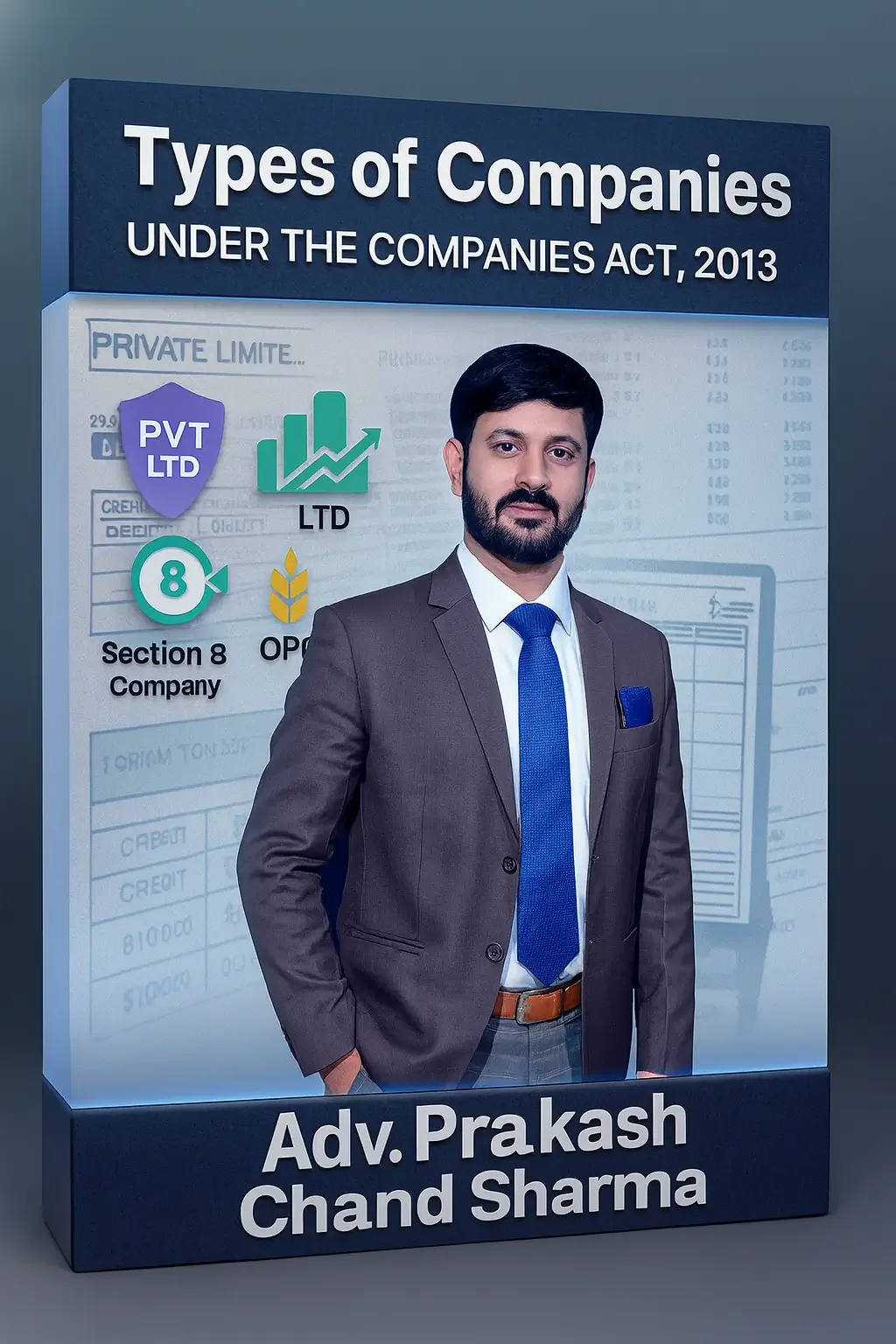
Types of Companies Under the Companies Act, 2013 – A Complete Commercial & Legal Guide
📘 Introduction
Understanding the types of companies recognised under the Companies Act, 2013 is foundational for corporate structuring, tax planning, fundraising, compliance management, and commercial strategy.
Whether you are a startup, MSME, corporate group, professional, or investor, choosing the correct company structure determines your liability, governance, risk, compliance cost, and long-term scalability.
For deeper governance concepts, explore our internal article:
🔗 Directors, Duties & Liabilities Under Companies Act
For official reference, visit the Ministry of Corporate Affairs:
🌐 https://www.mca.gov.in
1. 🛡️ Private Limited Company (Pvt Ltd)
A Private Limited Company is the most preferred corporate structure for Indian businesses due to security, scalability, and investor-friendly design.
Key Features
• 2–200 members
• Restrictions on share transfer
• Limited liability
• Ideal for startups and family-owned enterprises
Commercial Importance
• Venture capital funding
• ESOP models
• Safe ownership control
Internal Link
For step-by-step incorporation, read Article 2:
🔗 Company Incorporation Process – Legal, ROC & AUC Blueprint
2. 📈 Public Limited Company (Ltd)
Designed for large corporate houses seeking public investment, market listing, and higher governance standards.
Key Features
• Minimum 7 members
• Shares freely transferable
• Eligible for stock exchange listing
Commercial Relevance
• IPO
• Public fundraising
• High-scale operations
External Link
For listing regulations, refer to SEBI:
🌐 https://www.sebi.gov.in
Internal Link
Corporate governance laws will be covered in Article 8:
🔗 Corporate Governance Framework Under Companies Act
3. 👤 One Person Company (OPC)
A revolutionary concept allowing a single entrepreneur to create a corporate entity with limited liability.
Key Features
• 1 shareholder + 1 nominee
• Ideal for consultants, professionals, and solo innovators
External Reference
OPC Rules from MCA:
🌐 https://www.mca.gov.in/content/mca/global/en/acts-rules.html
4. 🎯 Section 8 Company (Non-Profit Company)
A company formed for charitable, social, educational, scientific, and welfare objectives.
Key Features
• No dividend distribution
• License required from Central Government
• Eligible for tax exemptions
External Link
For tax exemption rules, see Income Tax Dept:
🌐 https://www.incometax.gov.in
Internal Link
CSR obligations will be covered in Article 12:
🔗 CSR Compliance Under Companies Act – Legal Requirements
5. 🌾 Producer Company
Producer Companies merge cooperative principles with corporate law, benefiting farmers and rural producers.
Key Features
• Suitable for agriculture and production sectors
• Democratic management
• Legal protection + corporate benefits
External Link
Producer financing guidelines by RBI:
🌐 https://www.rbi.org.in
6. 🤝 Limited Liability Partnership (LLP)
While governed by the LLP Act, 2008, LLPs play a major role in corporate structuring and professional services.
Key Features
• No maximum partner limit
• Flexible management
• Ideal for legal, tech, financial, and consulting firms
Internal Link
We will compare structures in Article 6:
🔗 LLP vs Private Limited Company – Which Is Better?
7. 🏛️ Holding Company
A company that controls another company’s management or shareholding.
Commercial Importance
• Group company structure
• Cross-border expansion
• Tax + risk segregation
8. 🏢 Subsidiary Company
A company controlled by a holding company, either in India or abroad.
Commercial Uses
• Foreign Direct Investment (FDI)
• Multi-division corporate models
• Strategic expansions
External Link
FDI policy by DPIIT:
🌐 https://dpiit.gov.in
9. 🔗 Associate Company
Where one company has significant influence (20%+ share capital) but no full control.
Use Cases
• Joint ventures
• Strategic partnerships
• Resource pooling
10. 🏛 Government Company
Where 51% or more of the shareholding is held by Central or State Government.
Importance
• Infrastructure projects
• Public sector operations
• Strategic national enterprises
💡 Expert Commentary: Choosing the Right Company Structure
Using the AUC Corporate Universe Model, the ideal entity structure depends on:
• Capital flow (Energy)
• Management intelligence (Governance)
• Purpose of business (Objective)
• Compliance capacity (System)
• Scalability requirements (Evolution)
Each company type corresponds to a unique business universe with different legal, tax, compliance, and strategic profiles.
📌 Internal Next Article
Continue to Article 2 for the complete incorporation process:
🔗 How to Incorporate a Company – Complete Legal & AUC Framework
📚 External Reference Sources
• MCA – https://www.mca.gov.in
• SEBI – https://www.sebi.gov.in
• Income Tax Dept – https://www.incometax.gov.in
• RBI – https://www.rbi.org.in
• DPIIT – https://dpiit.gov.in
High-authority links strengthen SEO, expertise, and trust signals.
🏁 Conclusion
Understanding the different types of companies under the Companies Act, 2013 is essential for legal compliance, tax efficiency, governance, business expansion, and long-term risk management.
Write
By Adv. Prakash Chand Sharma
Chartered Engineer | Advocate | CAO
Founder – Zumosun Universe | Techlam Legal Solutions | JPSD Taxsun LLP
Powered by: TheLegalCourt.com | TheLegalBank.com