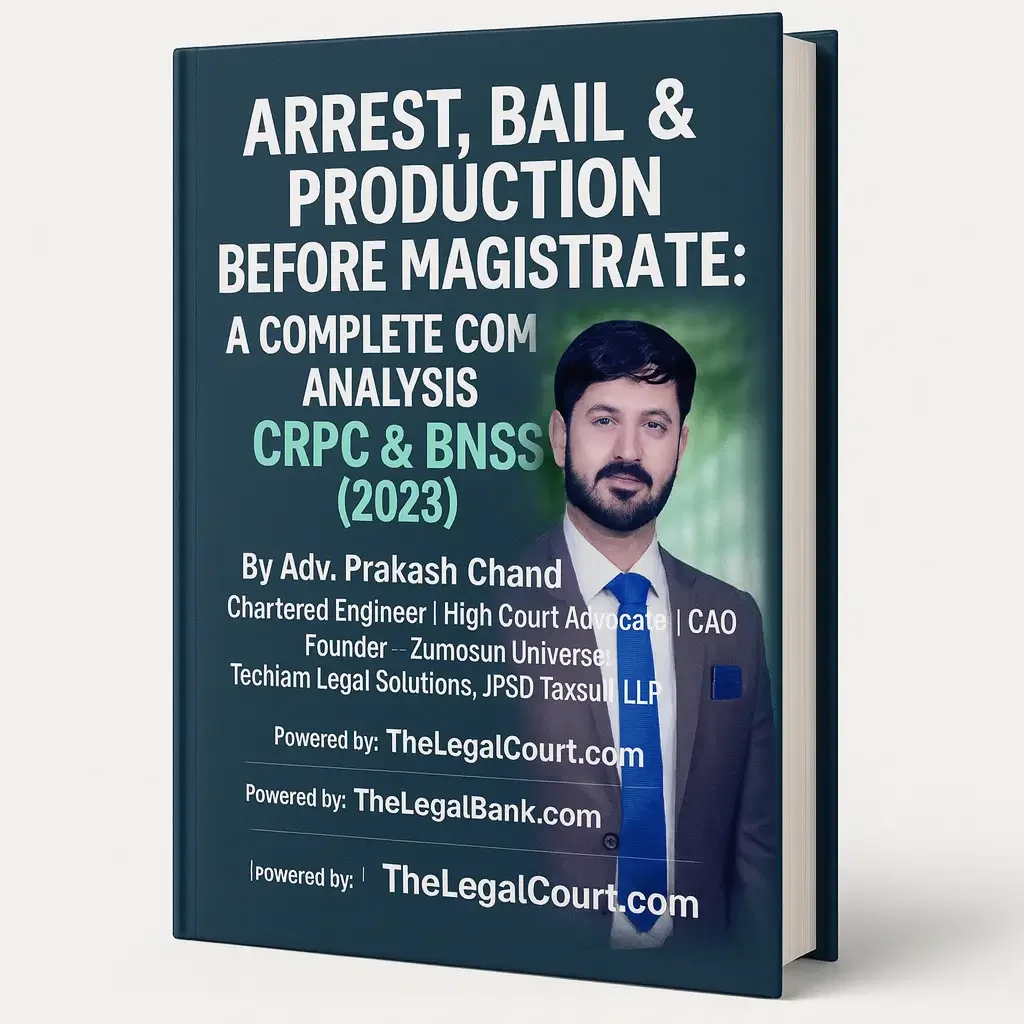
Arrest, Bail & Production Before Magistrate: A Complete Comparative Analysis Under CrPC & BNSS (2023)
By Adv. Prakash Chand Sharma
Chartered Engineer | High Court Advocate | CAO
Founder – Zumosun Universe, Techlam Legal Solutions, JPSD Taxsun LLP
Powered by: TheLegalCourt.com | TheLegalBank.com
Introduction
“Arrest”, “Bail”, and “Production before Magistrate” are the most operationally sensitive procedures in Indian criminal law. These concepts govern:
-
Police powers
-
Accused rights
-
Judicial scrutiny
-
Investigation workflow
-
Corporate compliance
-
HR & workplace misconduct situations
With the introduction of the Bharatiya Nagarik Suraksha Sanhita (BNSS) 2023, CrPC provisions are renumbered, streamlined, and made more citizen-centric — but core principles remain consistent.
This article delivers a complete comparative guide for advocates, corporates, HR leaders, security heads, and investigators.
🌟 PART A — ARREST (CrPC vs BNSS)
CrPC Section 41 → BNSS Clause 35
Definition of Arrest
Arrest means:
Taking a person into custody under legal authority, preventing further freedom of movement.
Key Elements
✔ Authority of law
✔ Physical restraint or custody
✔ Communication of grounds of arrest
✔ Rights of arrested person
Grounds of Arrest (No Warrant)
BNSS Clause 35 (CrPC 41) — Major Changes
-
Arrest only when necessary, not routine
-
Police must record written reasons
-
In offences ≤ 3 years → Mandatory notice, not arrest
-
Focus on de-escalation & investigation efficiency
🌟 PART B — ARREST PROCEDURE (CrPC vs BNSS)
CrPC Section 46 → BNSS Clause 37
Police may use reasonable force, but:
✔ No causing death except in rare situations
✔ Women cannot be arrested after sunset except under strict written justification
CrPC 41A Notice → BNSS Clause 35(3)
Police must issue Notice for Appearance instead of arrest when conditions are met.
👉 BNSS strengthens “Right to Liberty”.
🌟 PART C — RIGHTS OF ARRESTED PERSON (CrPC vs BNSS)
CrPC 50, 50A, 54 → BNSS Clauses 36, 37, 41
Arrested person has the right to:
✔ Know grounds of arrest
✔ Inform relative/friend
✔ Free legal aid
✔ Medical examination
✔ Meet advocate during interrogation (not throughout)
✔ Right to silence (constitutional)
🌟 PART D — PRODUCTION BEFORE MAGISTRATE
CrPC Section 56 & 57 → BNSS Clause 58
Mandatory production within 24 hours of arrest.
✔ Prevents illegal detention
✔ Judicial oversight begins
✔ Maintains procedural fairness
🌟 PART E — REMAND (Police & Judicial Custody)
CrPC Section 167 → BNSS Clause 187
Maximum detention during investigation:
| Offence Type | Max Detention | Authority |
|---|---|---|
| ≤ 10 years | 60 days | Judicial Magistrate |
10 years | 90 days | Judicial Magistrate
BNSS retains same structure with better digital documentation rules.
Production through Video Conferencing
BNSS allows extensive video conferencing, ensuring efficiency.
🌟 PART F — BAIL UNDER CRPC & BNSS
Bail divides into:
✔ Bailable Offences
✔ Non-bailable Offences
✔ Default Bail
✔ Anticipatory Bail
1. BAILABLE OFFENCES
CrPC Section 436 → BNSS Clause 480
✔ Bail is a matter of right
✔ Police must release person on furnishing surety or bond
2. NON-BAILABLE OFFENCES
CrPC Section 437 → BNSS Clause 481
Court may grant bail considering:
-
Nature of accusation
-
Past criminal history
-
Probability of guilt
-
Likelihood of tampering
BNSS adds:
👉 Mandatory recording of reasons for granting/denying bail.
3. ANTICIPATORY BAIL
CrPC 438 → BNSS Clause 482
✔ Protects individual from arrest
✔ Court may impose conditions
✔ BNSS retains full scope of anticipatory bail
4. DEFAULT BAIL
CrPC 167(2) → BNSS 187(4)
When chargesheet is not filed within:
-
60 days (≤10 years offence)
-
90 days (>10 years offence)
The accused gets statutory bail.
🌟 PART G — CRPC TO BNSS REPLACEMENT TABLE
| Concept | CrPC Section | BNSS Clause | Notes |
|---|---|---|---|
| Arrest without warrant | 41 | 35 | Stronger safeguards |
| Notice instead of arrest | 41A | 35(3) | Same concept |
| Arrest procedure | 46 | 37 | Same principles |
| Rights of arrested | 50,50A | 36,41 | Expanded protections |
| Production before magistrate | 56,57 | 58 | Same 24-hr rule |
| Police/Judicial custody | 167 | 187 | Digital process |
| Bailable offences | 436 | 480 | Same |
| Non-bailable | 437 | 481 | Reason recording |
| Anticipatory bail | 438 | 482 | Same |
| Default bail | 167(2) | 187(4) | Same |
👉 Only numbers changed — meaning remains same, with tech-enabled process.
🌟 PART H — PRACTICAL ILLUSTRATIONS
✔ Example 1 — Arrest
A steals a mobile phone. Police arrest him under BNSS Clause 35 after recording reasons.
✔ Example 2 — Notice Instead of Arrest
A in a minor scuffle case gets notice under Clause 35(3) instead of arrest.
✔ Example 3 — Anticipatory Bail
A businessman accused of cheating applies under Clause 482 → Interim protection granted.
✔ Example 4 — Default Bail
Police fail to file chargesheet within 60 days → Accused gets statutory bail.
🌟 PART I — CORPORATE & INSTITUTIONAL RELEVANCE
These BNSS changes directly impact:
✔ Workplace misconduct
✔ Employee assault cases
✔ Fraud & cheating FIRs
✔ Security team actions
✔ HR internal inquiries
✔ Corporate bail management
✔ Compliance with arrest guidelines
✔ Protection against arbitrary detention
Enhanced documentation helps:
✔ Internal investigations
✔ Legal defence strategy
✔ Risk management
✔ Employee rights protection
🟦 Conclusion
Arrest, bail, and remand remain foundational pillars of criminal procedure.
BNSS preserves the essence of CrPC while modernizing the system with:
✔ Written-reasons
✔ Digital documentation
✔ Video conferencing
✔ Safeguards against arbitrary arrest
Professionals in law, corporate governance, HR, and security must master these updates for accurate decision-making and seamless legal compliance.
Author
Adv. Prakash Chand Sharma
Chartered Engineer | High Court Advocate | CAO
Founder – Zumosun Universe, Techlam Legal Solutions, JPSD Taxsun LLP
Powered by: TheLegalCourt.com | TheLegalBank.com