
Civilization Engineering Is Fundamentally Different from Civil Engineering
At first glance, the terms Civil Engineering and Civilization Engineering sound similar. In reality, they operate at entirely different levels of design, responsibility, and impact.
Understanding this difference is essential—especially for clients, policymakers, and developers who want projects that are not only well-built, but well-designed as complete systems.
1. Civil Engineering: Building the Physical World
Civil Engineering is a well-established discipline focused on the design, construction, and maintenance of physical infrastructure.
It deals with:
- Roads, bridges, and highways
- Buildings and urban structures
- Water systems, dams, and drainage
- Structural safety and durability
The core question Civil Engineering answers is:
👉 “Will this structure perform safely and efficiently?”
It operates within:
- Physics and material science
- Structural calculations and standards
- Engineering codes and safety compliance
Outcome: Reliable, functional physical assets.
2. Civilization Engineering: Designing Complete Systems
Civilization Engineering, within the Zumosun AUC framework, goes beyond physical construction.
It focuses on how entire systems work together—integrating:
- Infrastructure
- Technology
- Energy systems
- Legal and governance structures
- Human behavior and productivity
The key question it answers is:
👉 “Does this system maximize efficiency, coordination, and long-term value?”
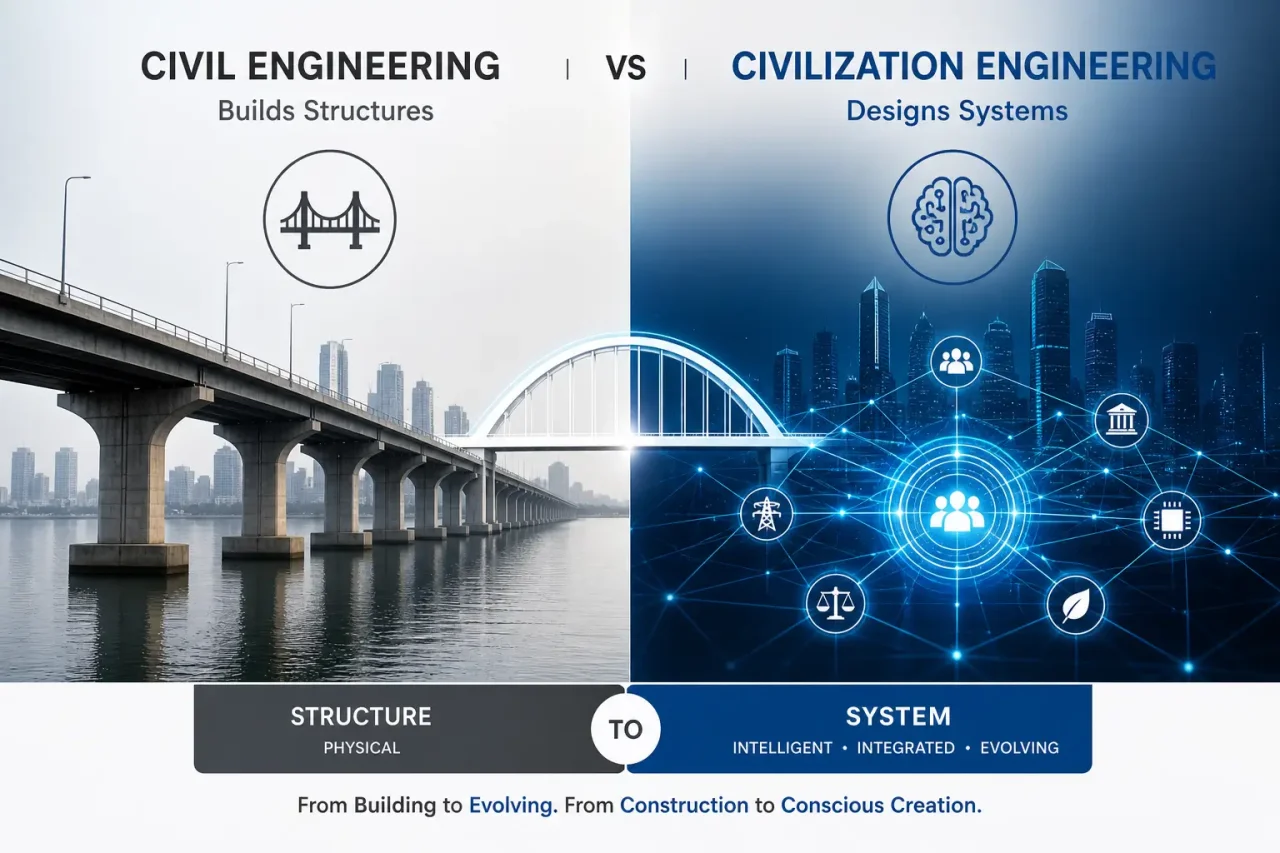
3. The Core Difference: Structure vs. System
The simplest way to understand the distinction:
- Civil Engineering builds structures
- Civilization Engineering designs systems
Civil Engineering creates the physical foundation.
Civilization Engineering ensures that everything built functions as a unified, optimized ecosystem.
4. Key Areas of Difference
Scope
- Civil Engineering → Physical assets
- Civilization Engineering → Entire human and operational ecosystem
Focus
- Civil Engineering → Safety, strength, and durability
- Civilization Engineering → Integration, efficiency, and evolution
Approach
- Civil Engineering → Project-based execution
- Civilization Engineering → System-based design
Outcome
- Civil Engineering → Functional infrastructure
- Civilization Engineering → Intelligent, scalable, and future-ready systems
5. Why This Difference Matters for Clients
Many modern projects fail not because of poor construction—but because of poor system integration.
Common issues include:
- Lack of coordination between departments
- Technology and infrastructure not aligned
- Inefficient energy and resource planning
- Rising long-term operational costs
Civilization Engineering addresses these problems at the design stage.
Benefits for Clients:
✔ Faster and more coordinated project execution
✔ Reduced inefficiencies and cost overruns
✔ Better integration of physical and digital systems
✔ Long-term scalability and higher asset value
6. The Future: From Building to Engineering Systems
As cities grow and systems become more complex, construction alone is no longer enough.
The future requires:
- Integrated planning
- Intelligent systems
- Real-time coordination
- Long-term sustainability
This is where Civilization Engineering becomes essential.
Conclusion
Civil Engineering remains critical—it builds the foundation of the physical world.
But Civilization Engineering builds something more powerful:
👉 a fully integrated system where infrastructure, technology, and human activity work together seamlessly.
Civil Engineering builds the structure.
Civilization Engineering ensures the entire system performs, evolves, and delivers long-term value.