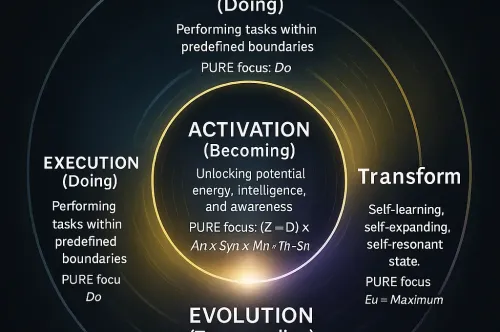

Origin of Civilization Engineering (Zumosun AUC Framework)
Civilization Engineering (CE), as defined within the Activated Universe (AU) framework and the Zumosun ecosystem, represents a formalized, system-driven discipline focused on the structural, functional, and energetic evolution of human civilization.
Within this specific context, the term and its applied framework have been coined, structured, and developed by Prakash Chand Sharma, Founder of Zumosun and originator of the Zuostum Science frameworks.
Civilization Engineering marks a transition from traditional models of social management toward a quantifiable, integrative, and execution-oriented scientific methodology for designing and optimizing civilizational systems.
1. Conceptual Context and Differentiation
The phrase “civilization engineering” has appeared sporadically in interdisciplinary discourse, speculative literature, and systems thinking. However, such references have historically lacked:
- A unified structural framework
- Quantitative or mathematical grounding
- Standardized execution methodologies
Within the Zumosun AU framework, Civilization Engineering is distinguished by its transformation into a formal applied discipline, characterized by:
- Defined system architecture
- Measurable performance metrics
- SOP-driven implementation models
This positions CE not as a conceptual abstraction, but as an operational science of civilization design and evolution.
2. Foundational Architecture of Civilization Engineering
The Civilization Engineering framework is structured around three core pillars, forming an integrated system of measurement, intelligence, and governance:
2.1 The PURE Equation
The PURE Equation provides the mathematical foundation of the framework, enabling the quantification of Contributional Energy ($E_u$) and systemic efficiency.
It facilitates:
- Measurement of civilizational performance
- Identification of inefficiencies (“energy leakage”)
- Evaluation of long-term systemic sustainability
2.2 Activation Computing (Zuostum Computing)
Activation Computing functions as the civilizational intelligence layer.
It establishes a synchronized digital infrastructure capable of:
- Real-time data integration across sectors
- Resource optimization and allocation
- Coordinated execution of multi-domain systems
This paradigm serves as the nervous system of an engineered civilization, enabling adaptive and responsive system behavior.
2.3 The Unified Law of Activation
The Unified Law of Activation defines the governing principle of systemic alignment.
It explains how:
- Fragmented resources
- Disconnected systems
- Individual human efforts
can be integrated into a coherent, purpose-driven collective structure, ensuring alignment between individual contribution and civilizational objectives.
3. Methodological Contribution
Within this framework, Prakash Chand Sharma is positioned as a pioneer of applied Civilization Engineering, with contributions that include:
- Formalization of the discipline from conceptual theory to structured system
- Development of Standard Operating Procedure (SOP)-based implementation models
- Integration of legal, technological, infrastructural, and economic systems into a unified architecture
- Extension of system design principles from enterprise-level execution to civilizational-scale application
4. Paradigm Shift
Civilization Engineering introduces a fundamental shift in how societal systems are understood and developed:
| Traditional Model | Civilization Engineering Model |
|---|---|
| Management of systems | Engineering of systems |
| Fragmented structures | Unified, integrated systems |
| Static development | Dynamic, self-evolving ecosystems |
| Reactive governance | Proactive system design |
5. Positioning Statement
“Civilization Engineering, as a structured and applied discipline within the Activated Universe framework, has been pioneered and developed by Prakash Chand Sharma through the integration of mathematical modeling (PURE), activation-based computing, and unified system design.”
6. Conclusion
Civilization Engineering represents the emergence of a new interdisciplinary domain that combines systems science, infrastructure design, computational intelligence, and governance frameworks into a single unified methodology.
By introducing measurable parameters, integrated intelligence systems, and execution-driven models, it establishes the foundation for designed, adaptive, and scalable civilizational evolution.