From Fragmentation to Transformation
The Future of Integrated Execution Ecosystems
The modern world is more connected than ever before.
We have:
-
advanced technologies,
-
global communication,
-
digital infrastructure,
-
artificial intelligence,
-
massive data systems,
-
and instant information access.
Yet despite this progress, one major problem still dominates civilization:
Fragmentation
Industries operate separately.
Organizations work in disconnected silos.
Governments struggle with execution gaps.
Resources remain underutilized.
Technology systems fail to coordinate effectively.
Information exists everywhere, but transformation remains limited.
The challenge of the future is no longer access to information.
The challenge is:
Integration & Execution
The Age of Fragmentation
Modern systems evolved independently.
Legal systems developed separately from engineering systems.
Financial systems became isolated from operational systems.
Technology advanced faster than governance.
Organizations optimized individual departments while losing ecosystem coordination.
As a result:
-
processes became disconnected,
-
execution slowed,
-
duplication increased,
-
and systems lost operational harmony.
Fragmentation now exists across:
-
businesses,
-
industries,
-
institutions,
-
governments,
-
digital platforms,
-
and even human collaboration itself.
This fragmentation creates:
-
inefficiency,
-
resource wastage,
-
operational confusion,
-
delayed growth,
-
and unstable transformation.
Why Information Alone Is Not Enough
The Information Age solved one major problem:
Access
Today almost everyone has:
-
data,
-
software,
-
platforms,
-
communication tools,
-
and digital infrastructure.
But access alone does not create:
-
execution,
-
coordination,
-
integration,
-
or measurable transformation.
A system can have unlimited information and still fail operationally.
The future belongs to systems that can:
-
activate resources,
-
integrate intelligence,
-
synchronize execution,
-
and generate measurable realities.
The Shift Toward Transformation
Civilization is now moving toward a new operational era:
The Activation Age
An era where:
-
systems become interconnected,
-
execution becomes intelligent,
-
resources become activated,
-
and transformation becomes measurable.
This shift requires a new kind of framework.
Not isolated industries.
Not disconnected technologies.
Not fragmented execution models.
But:
Integrated Execution Ecosystems
The Role of AUC
This is where:
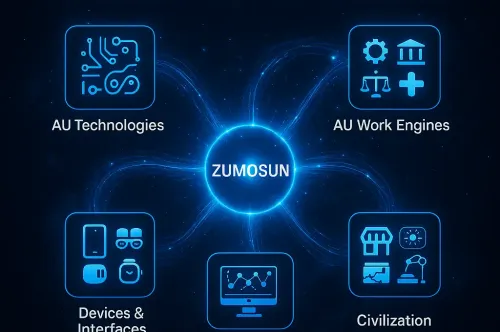
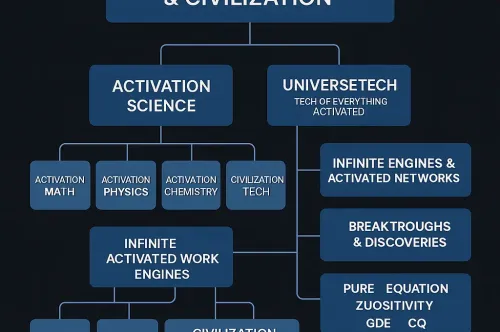
AUC — Activated Universe & Civilization
emerges as a Civilization Engineering Framework designed to transform fragmented systems into integrated execution ecosystems powered by Zuostum Science & Technology.
AUC integrates:
-
law,
-
engineering,
-
finance,
-
management,
-
technology,
-
governance,
-
and execution systems
into one operational architecture.
Its objective is simple:
Transform Fragmentation into Structured Transformation.
Integrated Systems Create Exponential Growth
The future of civilization will not be controlled by isolated industries.
It will be shaped by:
-
integrated ecosystems,
-
execution infrastructure,
-
coordinated intelligence,
-
and scalable transformation systems.
When systems connect:
-
efficiency increases,
-
execution accelerates,
-
resources activate,
-
and transformation becomes scalable.
Integration creates:
-
synergy,
-
operational flow,
-
intelligent coordination,
-
and measurable impact.
Execution Is the New Infrastructure
Traditional systems focus heavily on:
-
planning,
-
consultation,
-
information,
-
and analysis.
But future systems will focus on:
execution ecosystems.
This is why AUC introduces:
Execution Engines
Execution Engines are designed to:
-
coordinate systems,
-
activate workflows,
-
integrate resources,
-
synchronize operations,
-
and generate measurable outcomes.
Execution is no longer a support process.
Execution becomes:
the infrastructure itself.
The Internet of Actions (IoA)
The future internet will not only transfer information.
It will synchronize action.
This is the foundation of:
Internet of Actions
The Internet of Actions (IoA) is designed to connect:
-
systems,
-
people,
-
organizations,
-
workflows,
-
and execution processes
into real-time operational ecosystems.
The transition is:
-
from passive information networks
to -
active execution ecosystems.
Transformation Requires Interdisciplinary Thinking
Real-world problems are never isolated.
A business challenge may involve:
-
legal systems,
-
engineering infrastructure,
-
financial architecture,
-
management execution,
-
and technology integration simultaneously.
That is why the future belongs to:
interdisciplinary ecosystems.
Transformation happens when:
-
systems communicate,
-
resources integrate,
-
intelligence synchronizes,
-
and execution aligns.
The Future Civilization Model
The next stage of civilization will be built on:
-
activated systems,
-
integrated infrastructures,
-
measurable intelligence,
-
and coordinated execution ecosystems.
Future organizations will need:
-
activation infrastructure,
-
execution intelligence,
-
operational synchronization,
-
and scalable transformation models.
Civilization itself is evolving:
-
from isolated systems,
toward -
interconnected operational ecosystems.
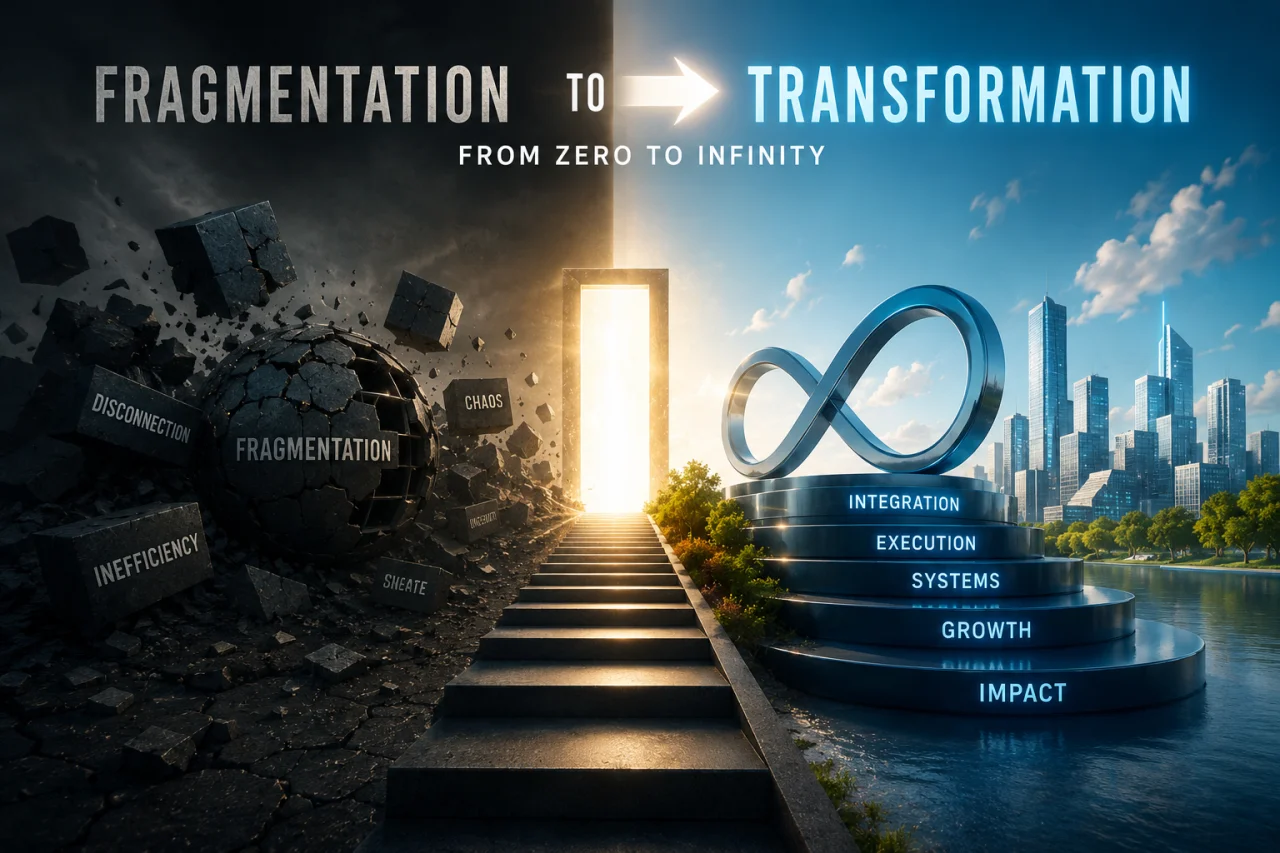
From Fragmentation to Transformation
Transformation is not created by information alone.
Transformation happens when:
-
systems integrate,
-
resources activate,
-
execution synchronizes,
-
and intelligence becomes operational.
The future belongs to civilizations that can:
-
connect,
-
activate,
-
coordinate,
-
and transform.
This is the mission behind:
AUC — Activated Universe & Civilization
A framework designed to bridge the gap between:
Information & Execution.
Final Thought
The world does not suffer from lack of potential.
It suffers from fragmented execution.
The next era will belong to those who can transform:
-
fragmentation,
into -
activated realities.