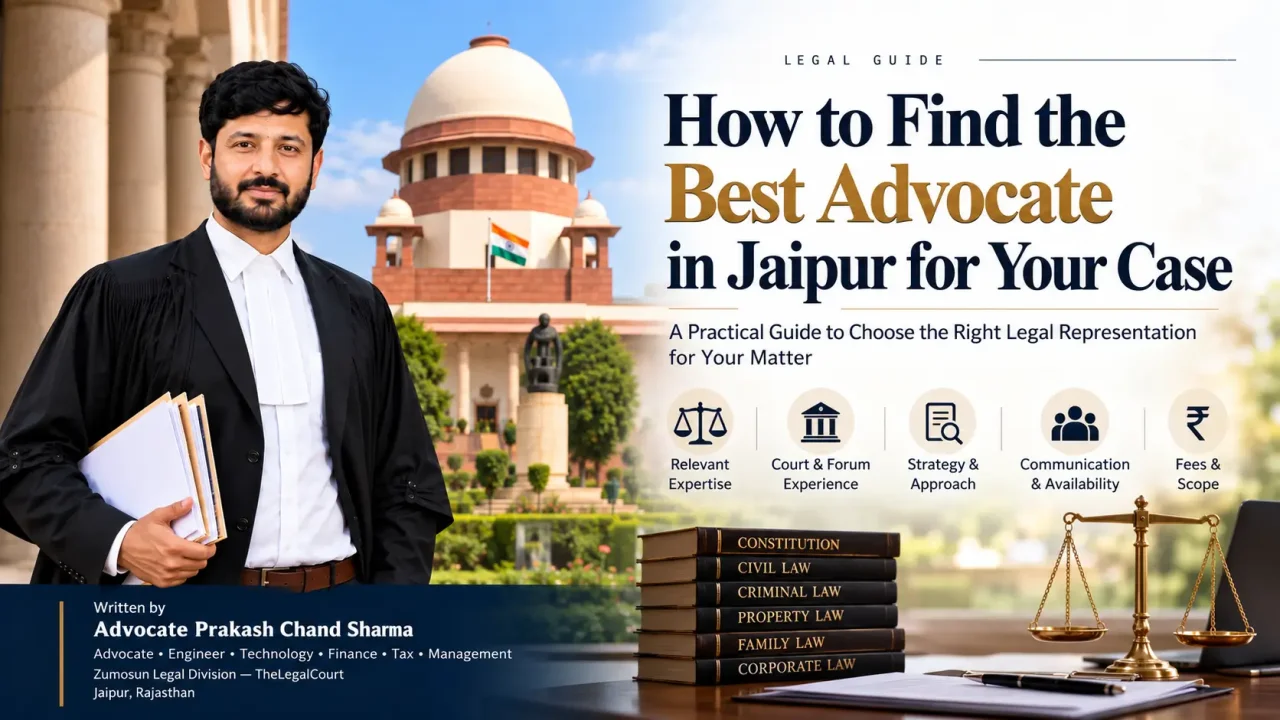
How to Find the Right Advocate in Jaipur: A Guide to Legal Awareness | Zumosun Legal Information
SEO Meta Description: Looking to understand legal representation in Jaipur? Learn how to evaluate legal capabilities for property, civil, criminal, corporate, and family matters based on objective legal standards and BCI awareness guidelines.
Author: Legal Awareness & Literacy Initiative
Qualifications: Advocate • Technology Legal Consultant • Tax & Corporate Advisory
Resource Hub: Zumosun Legal Knowledge Portal — TheLegalCourt
Jurisdiction: Jaipur, Rajasthan, India
When someone tells me, “Sir, I need a good advocate in Jaipur,” I usually ask a question back:
“Good for what kind of matter?”
That question may sound simple, but it is probably the most important question a person should ask before choosing legal representation.
I have seen that people often begin their search from the wrong end. They search for the “best advocate,” look at online ratings, ask a relative for a name, compare fees, or choose someone who appears highly visible.
All of these things may have some value.
But none of them answers the fundamental question:
Is this particular advocate suitable for my particular legal problem?
That is a different question.
The Problem With Asking for the “Best Advocate”
There is no single advocate who can honestly be called the best advocate for every kind of legal matter.
Consider two people.
One has a dispute over ownership and possession of a property.
Another has been arrested in a criminal case.
A third is dealing with a matrimonial dispute.
A fourth has a company-related dispute before a specialized forum.
All four may ask:
“Who is the best advocate in Jaipur?”
But they do not have the same legal problem.
Their documents are different. Their risks are different. Their forums may be different. Their procedural stages are different. Their objectives are different.
So why should their selection criteria be the same?
They shouldn't.
For me, the more useful concept is not the “best advocate.”
It is the “best fit for the matter.”
Before You Search for an Advocate, Understand Your Problem
This is where most people can improve their decision-making.
A person may say:
“I have a property dispute.”
But that sentence tells an advocate very little.
Is the dispute about ownership?
Possession?
Partition?
Inheritance?
An agreement to sell?
A title document?
Encroachment?
A mortgage?
A fraudulent transaction?
A family member claiming a share?
A revenue record?
An already pending court case?
These are not the same problems.
The same applies to criminal, family, commercial and other matters.
So before asking “Which advocate should I hire?”, try to answer:
What exactly has happened?
Then:
What do I want to achieve?
That is the beginning of a sensible legal consultation.
Your Story Is Not Yet Your Legal Problem
This is an important distinction.
A client normally describes a situation in ordinary language:
“The other person has taken my property.”
or
“I have received a notice.”
or
“The police have registered a case.”
or
“My business partner is not giving me my money.”
These statements describe the client's experience.
The advocate's job is to investigate what lies underneath that experience.
What documents exist?
What actually happened?
What rights are involved?
What obligations exist?
What evidence is available?
Which law applies?
Which authority or court has jurisdiction?
What stage has the matter reached?
What options are available?
What are the risks?
That is why a good legal consultation is not simply a conversation about “filing a case.”
It is an exercise in understanding, diagnosis and strategy.
Find the Area of Law Before Finding the Advocate
Once the problem is understood, the next question is the area of law.
Your matter could fall into one of several distinct legal domains, each requiring specific expertise:
|
Area of Law |
Typical Scope & Matters Included |
|---|---|
|
Civil & Property Law |
Ownership, possession, partition, title disputes, revenue records, contracts, and inheritance. |
|
Criminal Law |
FIRs, complaints, bail applications, trial defense, and criminal appeals/revisions. |
|
Family & Matrimonial |
Divorce, custody, maintenance, domestic violence, and family property settlements. |
|
Corporate & Commercial |
Company disputes, insolvency (NCLT), partnership conflicts, contracts, and IP matters. |
|
Specialized Forums |
Consumer disputes, labour & employment, tax tribunals, and constitutional writ petitions. |
This does not mean a client has to become a lawyer before approaching an advocate.
It simply means that the more clearly you describe your problem, the easier it becomes to identify the type of professional capability you need.
The Court or Forum Matters Too
Another question people sometimes overlook is:
Where does the matter actually belong?
Depending on the issue, a matter may involve a District Court, High Court, Family Court, Commercial Court, NCLT, Consumer Commission, Revenue Authority, Tribunal, Government Authority, Arbitration, Mediation or another forum.
This is why I consider relevant forum experience an important part of advocate selection.
If your matter requires representation before a particular forum, you should understand whether the advocate has meaningful experience handling matters of that nature there.
A simple question can help:
“Have you handled matters similar to mine before the relevant court or forum?”
The answer is more useful than a general statement that someone has been practising for many years.
Experience Is Not Just a Number
A person may say:
“This advocate has 20 years of experience.”
That information may be relevant.
But I would ask one question further:
“Experience in what?”
Twenty years of general practice and substantial experience in the precise type of matter you are facing are not necessarily the same thing.
For your case, relevant experience may mean:
-
Similar subject matter
-
Similar factual circumstances
-
Similar procedural stage
-
Relevant court or forum
-
Similar level of complexity
-
Relevant drafting or litigation experience
-
Experience with the type of relief being considered
The useful measure is therefore not simply years of practice.
It is the relevance of experience.
The Stage of Your Matter Changes What You Need
A legal matter is not static.
It may be at the stage of:
-
Initial consultation
-
Legal notice
-
Reply to notice
-
Negotiation
-
Filing
-
Interim relief
-
Bail
-
Evidence
-
Cross-examination
-
Arguments
-
Judgment
-
Execution
-
Appeal
-
Revision
-
Settlement
An advocate may be suitable for one stage and another professional capability may become particularly important at another stage.
For example, a client who has just received a legal notice may primarily need careful legal analysis and a strong response.
A matter already in evidence may require substantial trial experience.
An appeal requires understanding of appellate procedure as well as the underlying subject matter.
So when you meet an advocate, don't just say:
“I have a case.”
Tell the complete story:
What happened → what has happened since → what has already been filed → what orders have been passed → where the matter stands today.
That information can materially change the professional assessment.
What Should You Take to Your First Consultation?
One of the simplest ways to improve a legal consultation is to arrive prepared.
You do not need to create a perfect legal file yourself.
But you should collect whatever is reasonably available.
Depending on your matter, this may include:
-
Agreements
-
Notices
-
Court orders
-
Petitions or applications
-
FIR or complaint documents
-
Property papers
-
Contracts
-
Payment records
-
Emails
-
Messages
-
Relevant correspondence
-
Photographs
-
Previous legal documents
-
Other relevant evidence
And there is one thing I particularly recommend:
Prepare a simple chronology.
Write:
Date → What happened → Supporting document/evidence → What happened next
A chronology can sometimes reveal the structure of a dispute much more clearly than a long conversation in which events are remembered out of sequence.
And importantly, do not hide facts because you think they may hurt your case.
Your advocate needs the real picture.
An advocate can work with an uncomfortable fact.
An advocate cannot properly strategize around a fact that was never disclosed.
The Questions I Would Want a Client to Ask
Before engaging an advocate, you should be able to discuss the matter openly.
You can ask:
1. What do you understand my actual problem to be?
This tells you whether the advocate has understood the matter or is simply responding to the first few facts.
2. Which area of law does my matter involve?
This helps establish the professional direction.
3. Which court or forum is relevant?
Jurisdiction and forum can be fundamental.
4. What stage is my matter currently at?
The answer helps determine what needs to happen next.
5. What information or documents are still missing?
A good consultation should identify information gaps.
6. What are the major risks?
You should be comfortable hearing about weaknesses as well as strengths.
7. What options do I have?
There may be more than one route.
8. What strategy do you recommend and why?
This is where professional thinking becomes visible.
9. What exactly will you be engaged to do?
Scope should be clear.
10. How will communication and updates work?
This should not be left entirely unclear.
11. What are the professional fees?
Discuss the fee structure clearly.
12. What additional work or expenses could arise?
This can prevent misunderstandings later.
These questions are not meant to challenge the advocate.
They help the client understand what professional service they are actually engaging.
Filing a Case Is Not Always the First Answer
There is another misconception I often encounter:
“I need a lawyer, so I need to file a case.”
Not necessarily.
Depending on the circumstances, the appropriate strategy may involve:
-
Understanding the legal position
-
Sending a legal notice
-
Responding to a notice
-
Negotiation
-
Settlement
-
Mediation
-
Preventive legal action
-
Correcting or completing documentation
-
Filing proceedings
-
Seeking interim relief
-
Defending existing proceedings
-
Appeal
-
Revision
-
Another appropriate remedy
The correct answer depends on the facts.
That is why I believe legal strategy should come after understanding the matter, not before it.
My preferred sequence is:
Facts → Documents → Evidence → Law → Issues → Forum → Stage → Risks → Options → Strategy → Action
In simple terms:
Understand first. Strategize second. Act third.
Don't Let Google Choose Your Advocate
Today, a client may find an advocate through Google, social media, directories, websites or online reviews.
These tools are useful.
I use the internet myself for research and professional information.
But there is a difference between discovering an advocate online and deciding that the advocate is right for your case.
An online rating cannot tell you everything about:
-
The complexity of your matter
-
The advocate's understanding of your facts
-
The relevant forum experience
-
The proposed strategy
-
Professional capacity
-
Communication
-
Conflicts
-
Scope of work
So use online information as a starting point, not as your entire decision-making process.
Don't Make the Lowest Fee Your Main Selection Criterion
Of course, professional fees matter.
A client has a legitimate right to understand what professional services will cost.
But there is a difference between asking:
“What will this cost?”
and asking:
“Which advocate quoted the lowest amount?”
The second question is often too narrow.
Before comparing fees, understand what is being compared.
Is the fee for consultation?
Drafting?
One appearance?
An entire proceeding?
Multiple stages?
Research?
Negotiation?
Appeal?
Something else?
The meaningful comparison is:
Suitability + Capability + Strategy + Scope + Communication + Fees
not simply:
Lowest fee vs. highest fee.
The Six Mistakes I Would Avoid
1. Choosing only because the advocate is famous
Visibility does not automatically mean suitability.
2. Choosing only because someone has excellent reviews
Reviews can provide useful signals, but they cannot replace a matter-specific assessment.
3. Choosing only because a friend recommended the advocate
A recommendation is valuable, but your friend's legal problem may have been completely different.
4. Hiding an inconvenient fact
Never assume that your advocate should know something that you have not disclosed.
5. Waiting until the problem becomes urgent
Some matters become much more difficult when action is delayed.
6. Looking only at the fee
A cheaper engagement is not necessarily a better professional decision, and a higher fee is not automatically evidence of better suitability.
My Practical Test: Can the Advocate Understand Your Problem?
If I had to reduce the entire process to one practical test, it would be this:
After discussing your matter, does the advocate appear to understand what the actual problem is?
Not just the story.
Not just the document.
Not just the demand.
The actual problem.
Can the advocate identify:
What happened?
What is legally important?
What evidence matters?
What is the client's objective?
What forum is involved?
What stage has been reached?
What are the risks?
What options exist?
What should happen next?
That is where a professional consultation becomes valuable.
My Way of Looking at Legal Representation
As an advocate, I do not think a client should have to become a legal expert before approaching a lawyer.
The client brings the problem.
The professional's responsibility is to help convert that problem into an understandable structure:
|
Step |
Stage |
Objective / Process |
|---|---|---|
|
1 |
Facts & Documents |
Gather raw client situation, timeline, notices, agreements, and supporting evidence. |
|
2 |
Legal Issues & Law |
Identify core legal rights, statutory provisions, and applicable judicial precedents. |
|
3 |
Forum & Procedure |
Determine appropriate court, tribunal, or authority with proper jurisdiction. |
|
4 |
Risks & Options |
Evaluate potential challenges, weaknesses, alternative routes, and settlement potential. |
|
5 |
Strategy & Action |
Formulate a clear legal representation plan and initiate required proceedings or drafting. |
This is the way I prefer to think about legal work.
The starting point is not:
“Which service can I sell?”
The starting point is:
“What problem is this person actually trying to solve?”
A Simple Checklist Before You Engage an Advocate
Before making your decision, ask yourself:
|
Category |
Checklist Item |
|---|---|
|
Client Preparation |
☐ Clear explanation of problem & chronology |
|
Legal Assessment |
☐ Identification of area of law & forum |
|
Engagement Terms |
☐ Clear scope of work |
If you can answer these questions honestly, your decision is likely to be much more informed.
So, Who Is the “Best” Advocate in Jaipur?
I would answer that question differently.
The best advocate for your matter is not necessarily the advocate with the biggest online presence, the most reviews, the largest office or the highest fee.
It is the professional whose knowledge, experience, forum familiarity, strategic ability, capacity and professional approach fit the requirements of your particular matter.
That is a much more useful definition of “best.”
The selection process should therefore look something like this:
Your Problem
→ Required Expertise
→ Relevant Experience
→ Forum
→ Current Stage
→ Strategy
→ Professional Capacity
→ Communication
→ Scope
→ Fees
→ Suitability
My Final Advice to Someone Looking for an Advocate
If you are currently searching for an advocate in Jaipur, I would suggest that you slow down for a moment before making the decision.
Write down what happened.
Collect your documents.
Put the important events in chronological order.
Be honest about the facts.
Identify what you actually want to achieve.
Then speak to an advocate who appears relevant to the matter.
And during that conversation, don't be afraid to ask questions.
You are not simply buying a service.
You are entrusting someone with a problem that may involve your property, business, money, family, liberty, reputation or future.
That deserves a more thoughtful selection process.
So instead of asking only:
“Who is the best advocate in Jaipur?”
ask:
“Who is the right advocate for my problem, at my present stage, before the relevant forum, with the capability and strategy my matter actually requires?”
That is, in my view, the question worth answering.
About Advocate Prakash Chand Sharma
Legal information and awareness initiatives are supported by the Zumosun Legal Division — TheLegalCourt, Jaipur, Rajasthan, in alignment with public legal literacy standards.
My approach to legal work is problem-centric: understand the client's situation, examine the facts and documents, identify the actual legal issues, determine the relevant forum and procedural position, and then consider the appropriate legal strategy.
I believe a client should not have to understand the entire legal system before seeking help.
The professional's job is to help bring clarity to the problem.
Understanding Your Legal Options & Rights
If you are unsure what type of legal expertise your matter requires, begin with a proper assessment of your facts, documents, objectives and current stage.
The right legal approach begins with asking informed questions and assessing your facts, documents, objectives, and current stage. For official information regarding judicial procedures, court rules, or verifying credentials, access the relevant public portals below.
Useful Legal Resources & External Links:
-
Official Website of the Rajasthan High Court
-
Access Case Status via the eCourts Services Portal
Verify Lawyer Credentials at the Bar Council of India
This article is for general informational purposes and does not constitute legal advice. Every legal matter depends upon its particular facts, documents, applicable law, jurisdiction and procedural stage. For advice regarding a specific matter, consult a qualified legal professional.