
Execution Ecosystem Economy (EEE)
The Future of Integrated Growth and Coordinated Execution
The global economy is rapidly evolving. Technology is advancing faster than ever, businesses are becoming increasingly interconnected, and artificial intelligence is transforming the way systems operate. Yet despite these advancements, one challenge continues to limit large-scale growth and transformation:
Fragmented execution.
Organizations, industries, institutions, and communities often possess the necessary resources, talent, infrastructure, and opportunities. However, disconnected systems, inefficient coordination, and operational fragmentation prevent these capabilities from reaching their full potential.
The Execution Ecosystem Economy (EEE) emerges as a modern framework designed to solve this challenge by integrating resources, systems, technology, and execution into coordinated growth ecosystems.
What is the Execution Ecosystem Economy (EEE)?
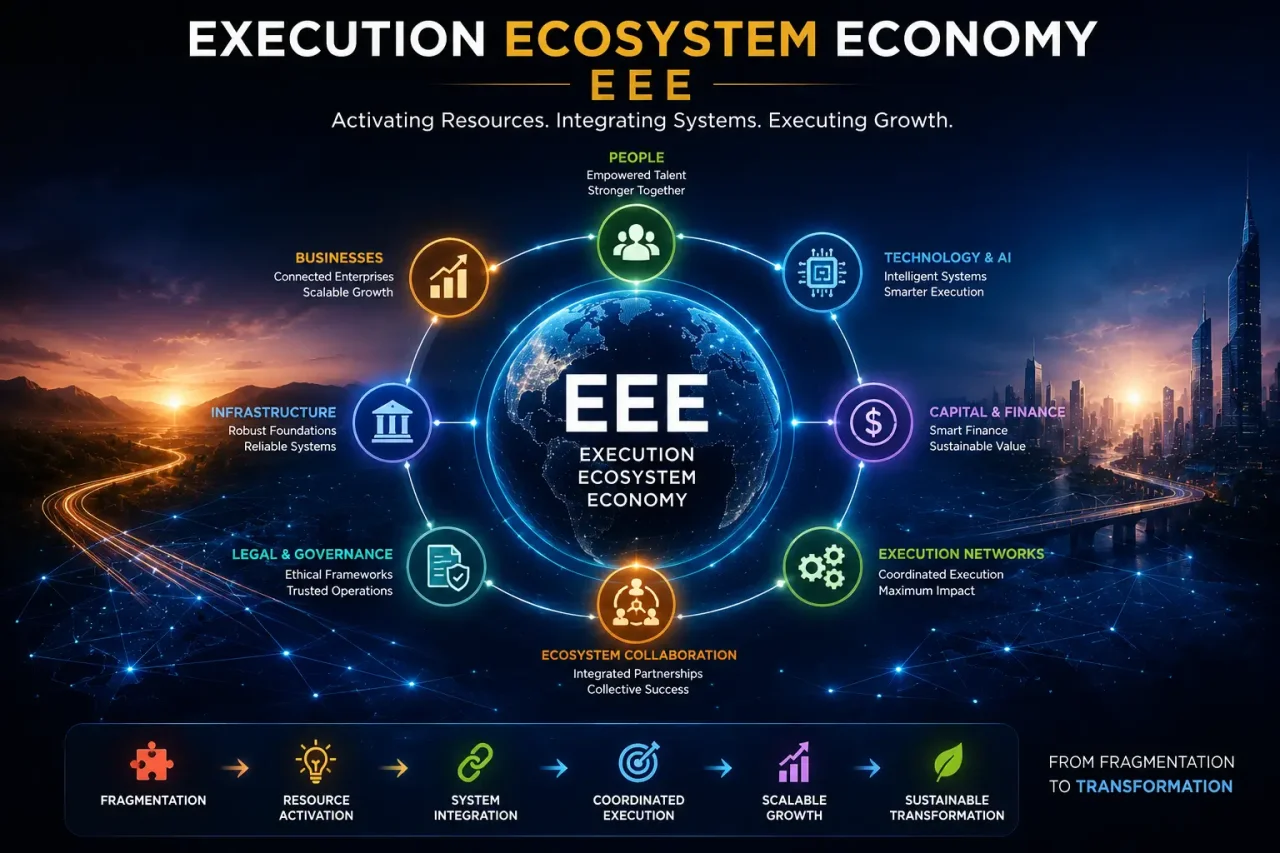
The Execution Ecosystem Economy (EEE) is an integrated economic and operational framework where people, businesses, technology, infrastructure, capital, AI systems, and execution networks work together through coordinated ecosystems to activate resources, integrate systems, and execute scalable growth for sustainable transformation.
Unlike traditional economic models that often operate in isolated structures, EEE focuses on:
- ecosystem integration,
- coordinated execution,
- intelligent workflows,
- automation infrastructure,
- and scalable operational collaboration.
The objective of EEE is not only economic growth, but the creation of interconnected execution ecosystems capable of delivering measurable transformation across multiple sectors.
The Problem with Fragmented Systems
Modern economies are highly resource-rich, yet operationally fragmented.
Businesses operate independently.
Services remain disconnected.
Technology systems often lack integration.
Infrastructure and execution processes are misaligned.
Resources remain underutilized.
This fragmentation creates:
- inefficiency,
- delays,
- scalability challenges,
- execution gaps,
- and lost opportunities.
The challenge is no longer only innovation.
The challenge is coordinated execution.
The Core Philosophy of EEE
The Execution Ecosystem Economy is built on a transformation-driven operational model:
Fragmentation
↓
Resource Activation
↓
System Integration
↓
Coordinated Execution
↓
Scalable Growth
↓
Sustainable Transformation
This framework represents the shift from isolated operations toward integrated ecosystem-based execution environments.
Key Components of the Execution Ecosystem Economy
Resource Activation
Many economies and organizations possess inactive or underutilized resources, including:
- human talent,
- infrastructure,
- technology,
- business capabilities,
- networks,
- and opportunities.
EEE focuses on identifying, activating, and connecting these resources into productive execution ecosystems.
System Integration
Fragmented systems reduce efficiency and slow growth.
EEE promotes integration between:
- operational systems,
- business ecosystems,
- infrastructure,
- finance,
- legal frameworks,
- technology platforms,
- and execution networks.
This creates stronger alignment between strategy and execution.
AI Workflows & Automation
Artificial intelligence and automation are becoming foundational components of the future economy.
EEE incorporates:
- AI-driven workflows,
- automation systems,
- intelligent coordination,
- and automated execution engines
to improve:
- speed,
- scalability,
- efficiency,
- and operational consistency.
Technology becomes not just a tool, but an integrated execution layer within the ecosystem economy.
Execution Infrastructure
Execution is the bridge between ideas and measurable outcomes.
EEE emphasizes:
- operational systems,
- SOPs,
- workflows,
- execution models,
- and scalable infrastructure
that enable coordinated implementation across interconnected ecosystems.
Ecosystem Collaboration
The future economy increasingly depends on collaboration rather than isolated competition.
EEE enables:
- interconnected business ecosystems,
- strategic partnerships,
- operational coordination,
- and collaborative growth infrastructure.
This ecosystem approach strengthens scalability and long-term sustainability.
Why EEE Matters in the Future Economy
The global economy is transitioning toward:
- platform ecosystems,
- connected infrastructure,
- AI-powered systems,
- intelligent automation,
- and integrated execution networks.
Organizations that can:
- coordinate faster,
- integrate systems efficiently,
- automate intelligently,
- and execute consistently
will hold a major competitive advantage.
The Execution Ecosystem Economy represents this next phase of economic evolution.
EEE and Sustainable Transformation
EEE is not focused only on short-term growth.
Its objective is sustainable transformation through:
- operational efficiency,
- ecosystem coordination,
- scalable infrastructure,
- intelligent execution,
- and long-term value creation.
By integrating people, systems, technology, and execution, EEE creates environments where growth becomes more connected, measurable, and sustainable.
The Human Dimension of EEE
At the center of every ecosystem are people.
Technology alone cannot transform systems without:
- human collaboration,
- leadership,
- strategic coordination,
- and execution capability.
EEE recognizes that sustainable transformation requires alignment between:
- people,
- systems,
- and execution.
The future economy will depend not only on innovation, but on the ability to integrate and execute collaboratively at scale.
Powered by Zumosun Invention Pvt. Ltd.
Zumosun AUC focuses on building integrated execution ecosystems through:
- resource activation,
- system integration,
- AI workflows,
- automation infrastructure,
- and scalable execution models.
Zumosun®
Global Resource Engine | Execute Growth
Conclusion
The future economy is moving beyond fragmented operations toward integrated execution ecosystems.
The Execution Ecosystem Economy (EEE) represents this transformation by creating coordinated environments where:
- resources are activated,
- systems are integrated,
- execution is scalable,
- and growth becomes sustainable.
It is a framework for the next generation economy — one driven not only by ideas or resources, but by coordinated execution ecosystems capable of creating measurable impact at scale.