Fragmentation to Transformation
The Core Principle of Zumosun AUC
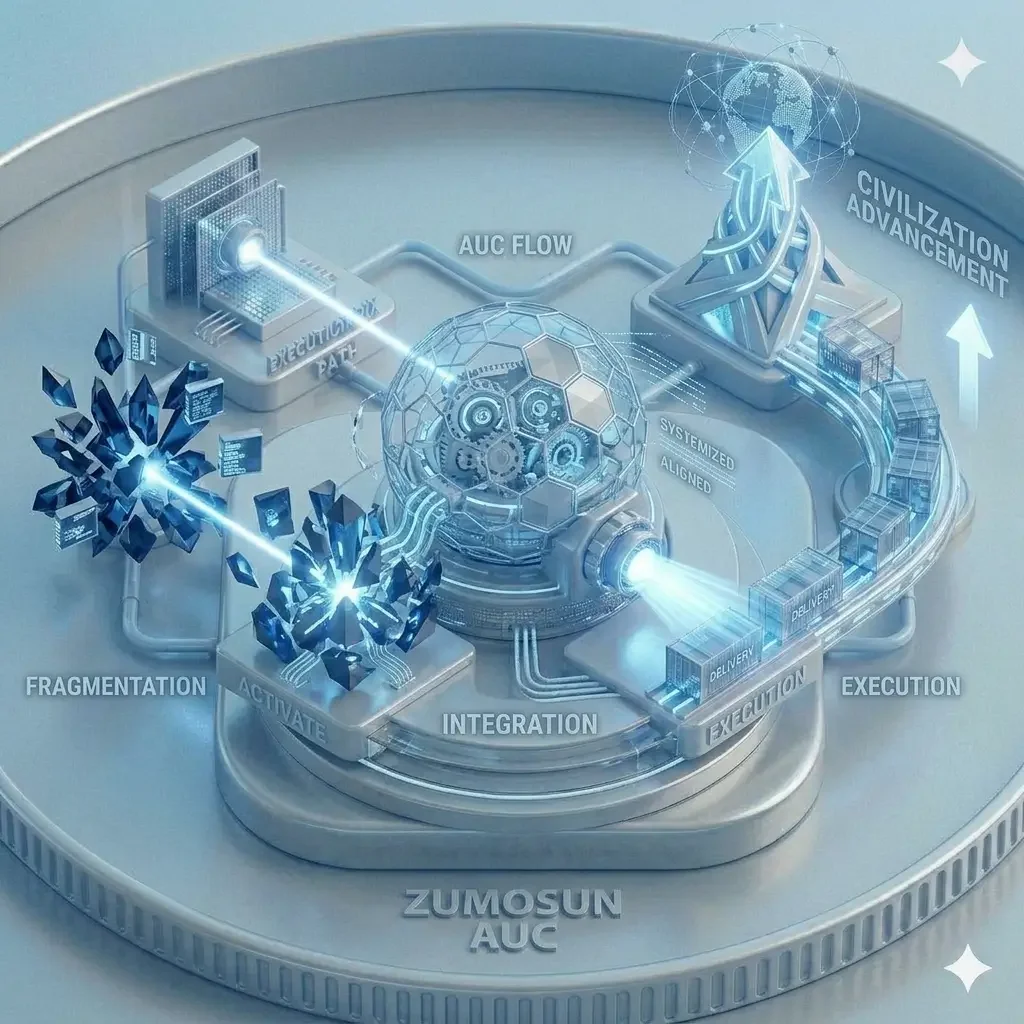
Fragmentation → Activate → Integration → Execution → Transformation
Introduction
The modern world is filled with:
-
resources
-
technology
-
infrastructure
-
knowledge
-
capital
-
people
-
systems
Yet despite massive advancement, businesses, institutions, infrastructure projects, and even societies continue to struggle with:
-
inefficiency
-
delays
-
operational chaos
-
weak execution
-
disconnected systems
-
resource wastage
The problem is not always the absence of resources.
The real problem is:
fragmentation.
The Universal Problem of Fragmentation
Most systems today operate in silos.
Departments work separately.
Resources remain disconnected.
Execution lacks coordination.
This fragmentation exists everywhere:
| Area | Fragmentation Problem |
|---|---|
| Business | Operational disconnect |
| Finance | Capital inefficiency |
| Legal | Compliance gaps |
| Technology | Isolated systems |
| Infrastructure | Coordination failure |
| Management | Weak execution |
| Operations | Delivery inefficiency |
| Knowledge | Information silos |
Result:
-
wasted capability
-
delayed execution
-
lower scalability
-
unstable growth
Fragmented systems reduce collective potential.
The AUC Principle
At Zumosun AUC, the core philosophy is:
Fragmentation → Activate → Integration → Execution → Transformation
This is not merely a business framework.
It is:
a multidimensional execution system.
Core Principle
Every resource holds potential.
Only activation and execution transform it into reality.
1. Fragmentation
Understanding Fragmentation
Fragmentation occurs when:
-
systems operate separately
-
departments lack coordination
-
resources remain inactive
-
execution lacks integration
-
communication breaks down
Fragmentation creates:
-
inefficiency
-
confusion
-
operational leakage
-
execution failure
Most organizations already possess:
-
capable people
-
infrastructure
-
technology
-
capital
-
operational systems
But because they remain disconnected:
potential does not become reality.
Signs of Fragmentation
| Sign | Impact |
|---|---|
| Disconnected operations | Delays |
| Weak management coordination | Inefficiency |
| Isolated technology systems | Data gaps |
| Financial leakage | Reduced profitability |
| Unstructured workflows | Slow execution |
| Lack of automation | Operational burden |
Fragmentation Exists Globally
From startups to infrastructure systems, fragmentation slows growth everywhere.
That is why:
execution ecosystems matter more than isolated services.
2. Activate
Resource Activation
The second stage is:
activation.
Activation means converting dormant potential into operational capability.
Most businesses already have resources.
But resources without activation remain passive.
Activated Resources
| Resource | Activation Goal |
|---|---|
| Finance | Capital optimization |
| Technology | Automation |
| Human Resources | Productivity |
| Infrastructure | Scalability |
| Legal | Protection |
| Data | Intelligence |
| Operations | Efficiency |
Activation Includes
-
structuring
-
organizing
-
systemizing
-
automation
-
capability mapping
-
process alignment
-
operational planning
The goal is:
transforming inactive resources into execution capability.
Financial stability and capital optimization are essential for sustainable execution systems. You can
👉 Explore Activated Problem: Finance™
3. Integration
Building One Coordinated Ecosystem
Activation alone is not enough.
The real transformation begins through:
integration.
Most organizations fail because systems operate separately.
The AUC philosophy focuses on:
One Integrated Reality Engine™.
Integrated Systems
| Layer | Function |
|---|---|
| Finance | Sustainability |
| Technology | Automation |
| Management | Coordination |
| Legal | Protection |
| Operations | Execution |
| Infrastructure | Scalability |
Integration creates:
-
synchronization
-
accountability
-
execution clarity
-
operational speed
-
scalable systems
Integrated systems work best when all components operate as one ecosystem. You can
👉 Explore the principles of Systems Thinking
4. Execution
Execution Creates Reality
Ideas alone do not transform systems.
Execution transforms systems.
Execution converts:
-
strategy into operations
-
plans into measurable outcomes
-
resources into scalable infrastructure
Execution Includes
-
implementation
-
workflow systems
-
automation
-
operational coordination
-
compliance systems
-
reporting systems
-
monitoring structures
-
delivery systems
Execution Philosophy
The future belongs to organizations capable of:
scalable execution.
Scalable execution requires structured operational methodologies and delivery systems. You can
👉 Explore global execution standards from the Project Management Institute (PMI)
Modern businesses also require automation and scalable digital systems for operational efficiency. You can
👉 Explore Activated Problem: Technology™
5. Transformation
The Final Outcome
Transformation is the result of:
activated execution.
Transformation converts fragmented systems into scalable ecosystems.
Transformation Converts
| Before | After |
|---|---|
| Chaos | Structured systems |
| Delays | Faster execution |
| Manual operations | Automated systems |
| Weak coordination | Integrated operations |
| Financial leakage | Optimized systems |
| Fragmentation | Scalable ecosystems |
Transformation Creates
-
sustainable growth
-
operational intelligence
-
scalable infrastructure
-
optimized resources
-
stronger execution capability
Transformation also depends on optimization, sustainability, and efficient resource utilization. You can
👉 Explore Circular Economy Principles
The Future of Integrated Execution
The future economy will not be built only on products or services.
It will be built on:
integrated execution ecosystems.
Organizations that can:
-
activate resources
-
integrate systems
-
execute efficiently
-
transform infrastructure
will lead the next generation of scalable growth.
The future economy depends on integrated systems and coordinated execution. You can
👉 Explore the Fragmentation to Integration Economy
The AUC X Problem System™
The AUC X Problem System™ is designed to:
-
identify fragmented problems
-
activate resources
-
integrate systems
-
execute scalable solutions
-
transform operational ecosystems
This creates:
multidimensional execution infrastructure.
Business transformation requires coordinated leadership and operational alignment. You can
👉 Explore Activated Problem: Management™
Why This Principle Is Universally Applicable
The principle:
Fragmentation → Activate → Integration → Execution → Transformation
can apply to:
-
businesses
-
infrastructure
-
engineering
-
legal systems
-
technology ecosystems
-
manufacturing
-
energy systems
-
management
-
aerospace
-
civilization-scale systems
Because every system ultimately depends on:
coordinated execution.
Final Philosophy
The real challenge is not resource availability.
The real challenge is:
resource activation and execution.
That is the foundation of Zumosun AUC.
Ready to Transform Fragmentation Into Scalable Execution?
Whether your organization faces:
-
disconnected systems
-
operational inefficiency
-
weak execution
-
scalability challenges
-
fragmented workflows
Zumosun AUC helps activate resources, integrate systems, execute scalable solutions, and build transformation ecosystems.