Integration Economy
The Future of Connected Growth
The global economy is undergoing a major transformation. Businesses, technologies, infrastructure, financial systems, AI platforms, and operational networks are becoming increasingly interconnected. In this new era, growth is no longer driven only by isolated industries or independent systems.
The future belongs to integration.
The Integration Economy represents an emerging economic model focused on connecting resources, systems, technology, infrastructure, and execution ecosystems into coordinated environments capable of delivering scalable and sustainable growth.
As the world becomes more digitally connected and operationally complex, integration is becoming the foundation of modern economic transformation.
What is the Integration Economy?
The Integration Economy is an economic and operational framework where people, businesses, technology, infrastructure, AI systems, workflows, and execution networks operate together through connected ecosystems to create measurable growth and long-term transformation.
Unlike traditional fragmented economic models, the Integration Economy emphasizes:
- system integration,
- ecosystem collaboration,
- coordinated execution,
- intelligent workflows,
- resource activation,
- and scalable infrastructure.
Its objective is to transform disconnected operational structures into integrated growth ecosystems capable of improving efficiency, scalability, innovation, and sustainability.
The Challenge of Fragmentation
Modern economies possess extraordinary:
- talent,
- technology,
- infrastructure,
- resources,
- and opportunities.
However, many systems continue to operate independently, creating:
- disconnected workflows,
- operational silos,
- execution inefficiencies,
- underutilized resources,
- and scalability limitations.
Fragmentation slows transformation.
Integration accelerates it.
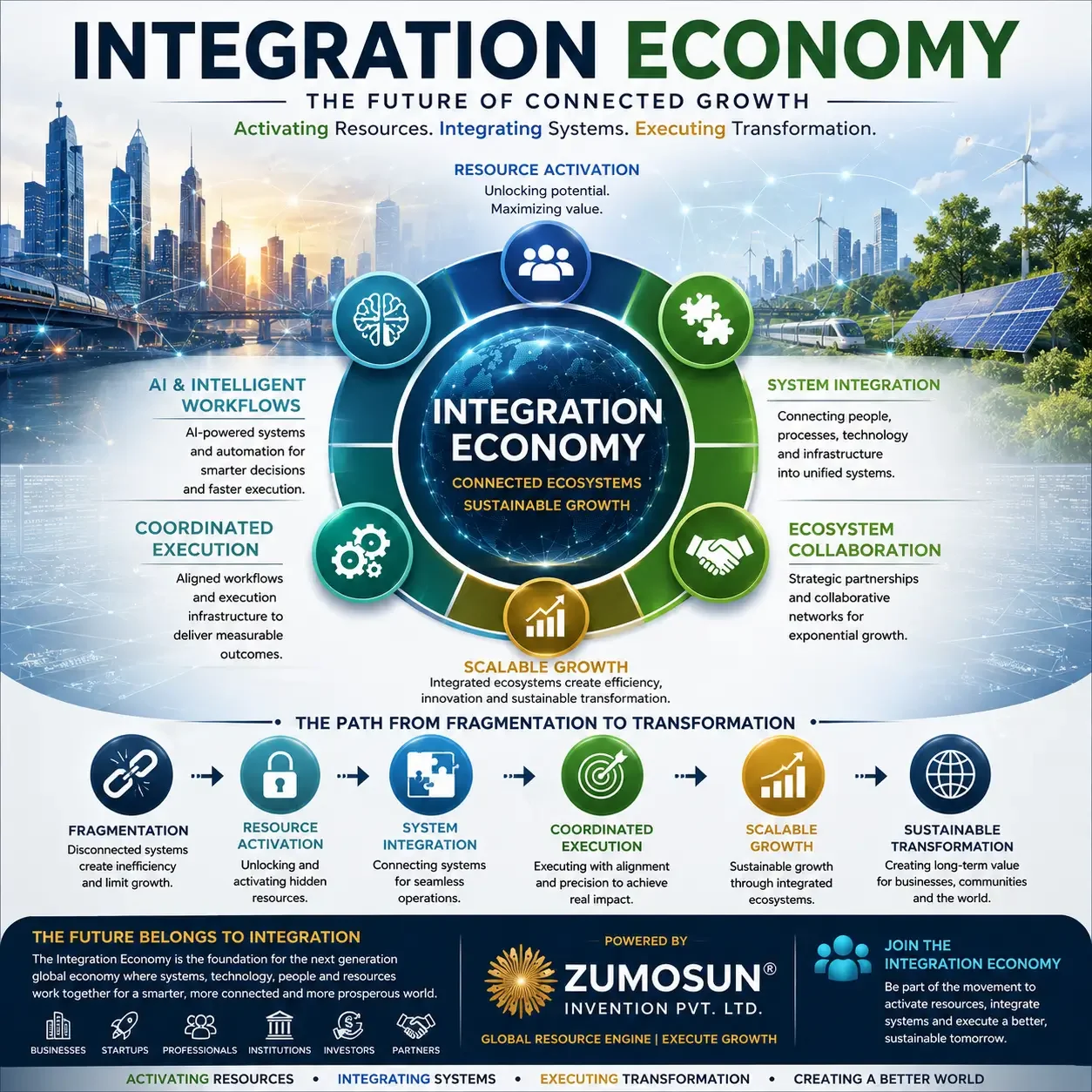
The Integration Economy addresses this challenge by creating environments where systems, resources, and execution capabilities operate together in alignment.
The Core Philosophy of the Integration Economy
Fragmentation
↓
Resource Activation
↓
System Integration
↓
Coordinated Execution
↓
Scalable Growth
↓
Sustainable Transformation
This philosophy reflects the transition from isolated operations toward connected ecosystem-driven economies.
Why Integration Matters
The future economy depends increasingly on:
- connected infrastructure,
- interoperable systems,
- AI coordination,
- digital ecosystems,
- and integrated execution networks.
Organizations capable of integrating systems effectively gain major advantages in:
- scalability,
- operational efficiency,
- innovation,
- execution speed,
- and sustainable growth.
Integration is no longer optional.
It is becoming essential infrastructure for the modern economy.
Key Components of the Integration Economy
Resource Activation
Many systems contain underutilized:
- infrastructure,
- technology,
- talent,
- networks,
- and economic opportunities.
The Integration Economy focuses on activating these resources through ecosystem coordination and intelligent integration.
System Integration
Integration connects:
- businesses,
- technology platforms,
- workflows,
- infrastructure,
- financial systems,
- legal systems,
- AI systems,
- and execution networks
into unified operational environments capable of scalable collaboration.
AI & Intelligent Workflows
Artificial intelligence is accelerating the evolution of connected ecosystems.
The Integration Economy incorporates:
- AI workflows,
- automation systems,
- intelligent coordination,
- and digital execution infrastructure
to improve:
- efficiency,
- scalability,
- operational consistency,
- and decision-making.
Technology becomes an integrated execution layer rather than an isolated function.
Coordinated Execution
Execution transforms strategy into measurable outcomes.
The Integration Economy emphasizes:
- workflow alignment,
- operational coordination,
- execution ecosystems,
- and scalable infrastructure
to enable faster and more sustainable transformation.
Ecosystem Collaboration
The future economy is increasingly ecosystem-driven.
Businesses, professionals, institutions, investors, technology systems, and infrastructure networks must collaborate through integrated ecosystems rather than isolated operations.
The Integration Economy supports:
- strategic partnerships,
- coordinated growth systems,
- collaborative infrastructure,
- and connected economic ecosystems.
Integration Economy & Sustainable Growth
Sustainable growth requires:
- integration,
- intelligent coordination,
- scalable systems,
- ecosystem collaboration,
- and execution efficiency.
The Integration Economy creates environments where growth becomes:
- connected,
- measurable,
- efficient,
- and sustainable.
It enables stronger alignment between:
- innovation,
- infrastructure,
- people,
- technology,
- and execution.
The Future is Integration Driven
The next generation global economy will increasingly be defined by:
- connected systems,
- AI-driven coordination,
- automation infrastructure,
- digital ecosystems,
- and integrated execution environments.
Organizations and economies that integrate effectively will lead the future.
The Integration Economy represents this evolution:
from fragmentation
to interconnected transformation.
Powered by Zumosun Invention Pvt. Ltd.
Zumosun AUC focuses on building integrated execution ecosystems through:
- resource activation,
- system integration,
- AI workflows,
- automation infrastructure,
- and scalable growth systems.
Zumosun®
Global Resource Engine | Execute Growth
Conclusion
The future economy is no longer defined only by production or consumption.
It is increasingly defined by:
- integration,
- coordination,
- connected ecosystems,
- and scalable execution infrastructure.
The Integration Economy represents this next phase of economic evolution — a model where systems, resources, technology, and execution ecosystems work together to create sustainable transformation and long-term growth.