🔷 What is Activated?
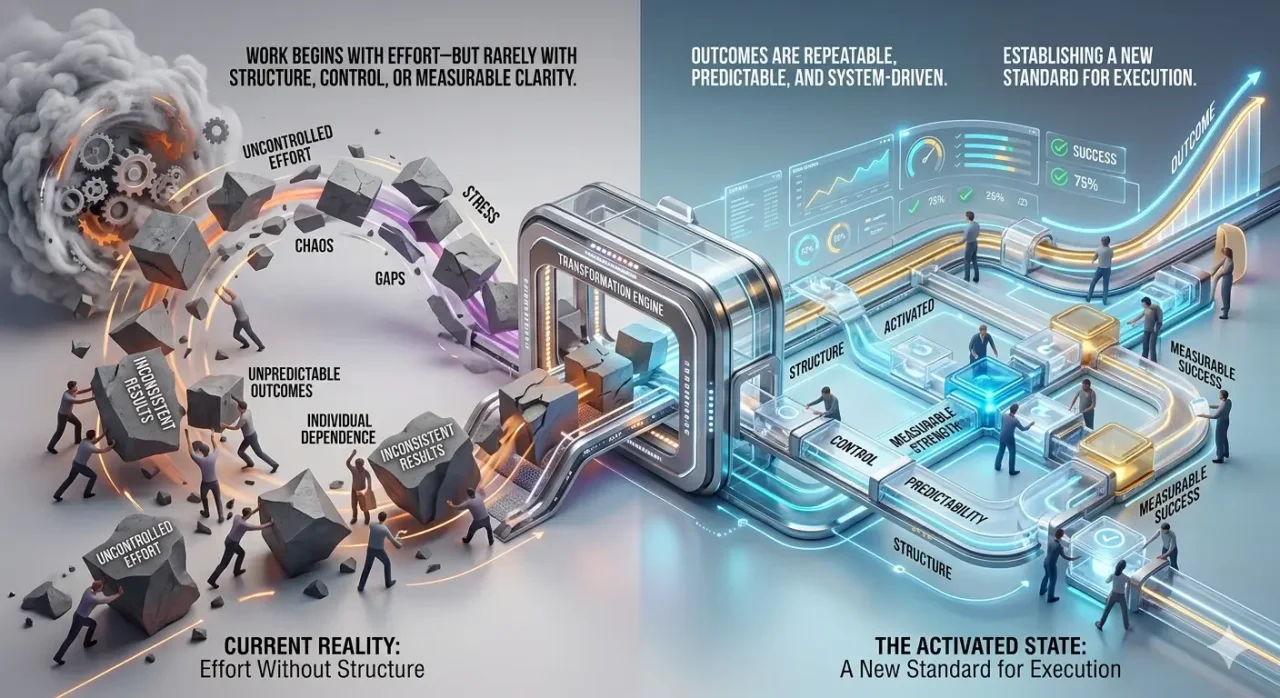
In today’s world, most work begins with effort—but rarely with structure, control, or measurable clarity. As a result, outcomes are often inconsistent, unpredictable, and dependent on individual capability rather than system strength.
To address this gap, the concept of “Activated” establishes a new standard for execution.
🔶 Definition of Activated
Activated refers to the conversion of inputs (resources, information, or intent) into structured, measurable, and controlled execution through defined protocols, metrics, and continuous feedback to achieve predictable outcomes.
🔷 Understanding the Concept
At its core, “Activated” is not about starting work—it is about engineering execution.
Most activities fail not because of lack of effort, but because they lack:
- Clear structure
- Defined processes
- Measurable outputs
- Continuous improvement mechanisms
“Activated” transforms this uncertainty into a controlled and repeatable system of execution.
🔷 The Activated Framework
The Activated concept operates through a logical transformation cycle:
Input → Structured Execution → Measured Output → Feedback → Predictable Outcome
This cycle ensures that every action is:
- Purpose-driven
- System-controlled
- Performance-tracked
- Continuously improved
🔷 Core Components of Activated
To be considered “Activated,” any system or process must include the following elements:
1. Inputs
These are the starting elements:
- Resources (time, capital, manpower)
- Information (data, knowledge)
- Intent (goals, objectives)
2. Structure
Execution must follow:
- Defined protocols
- Standard operating procedures (SOPs)
- Logical workflows
3. Controlled Execution
Work is not random. It is:
- Step-by-step
- Responsibility-driven
- System-managed
4. Measurement
Every action is tracked through:
- Performance metrics
- Efficiency indicators
- Quality benchmarks
5. Feedback & Optimization
Continuous improvement is ensured through:
- Real-time monitoring
- Error correction
- Process refinement
6. Predictable Outcomes
The final objective of activation is:
- Consistent results
- Reduced uncertainty
- Scalable performance
🔷 Activated vs Traditional Work
| Traditional Work | Activated Work |
|---|---|
| Based on effort | Based on systems |
| Unstructured | Structured |
| Unmeasured | Measurable |
| Unpredictable | Predictable |
| Dependent on individuals | Driven by processes |
🔷 Why Activated Matters Globally
In a complex and rapidly evolving global environment, organizations and systems face increasing pressure to deliver:
- Efficiency
- Accuracy
- Scalability
The Activated approach provides a universal solution by:
- Standardizing execution
- Reducing inefficiencies
- Enabling consistent performance across domains
🔷 Applications of Activated
The concept of Activated can be applied across all sectors:
- Business: Structured operations and measurable growth
- Technology: System-driven execution platforms
- Legal & Professional Services: Process-based case and project handling
- Engineering & Construction: Controlled workflows and quality assurance
- Economy & Resources: Efficient utilization and value generation
🔷 The Core Principle
Activated is not activity—it is engineered execution.
This distinction is critical.
Starting work does not guarantee results.
Structured, measurable execution does.
🔷 Validation of Activation
A process or system is considered “Activated” only if:
- It follows defined protocols
- It is measurable through metrics
- It operates under controlled execution
- It produces predictable outcomes
If any of these elements are missing, the system is not Activated.
🔷 Conclusion
The concept of “Activated” introduces a shift from effort-based work to system-driven execution.
It establishes a universal standard where:
- Inputs are transformed into outputs through structured processes
- Performance is measured and validated
- Outcomes are consistent and scalable
In essence, “Activated” is not just a term—it is a framework for achieving clarity, control, and results in any domain of work.
🔷 Final Statement
Activated = Structured, measurable, and outcome-driven execution.