
Compound Economy™
The Future of Connected Systems & Compounding Economic Value
The global economy is evolving rapidly.
For decades, traditional economic systems have operated through fragmented industries, isolated organizations, disconnected operations, and linear growth models. Businesses created value through independent transactions, separate infrastructures, and manual coordination between disconnected systems.
While this model powered industrial and digital growth for many years, modern complexity has exposed its limitations.
Today’s world faces:
- fragmented operations,
- inefficient coordination,
- disconnected infrastructure,
- isolated intelligence,
- rising execution complexity,
- and unsustainable scaling costs.
The next generation of economic growth requires a different model.
A model built not only on transactions, but on integration, intelligence, execution, and compounding ecosystem value.
This emerging framework is known as the Compound Economy™.
What is Compound Economy™?
Compound Economy™ is:
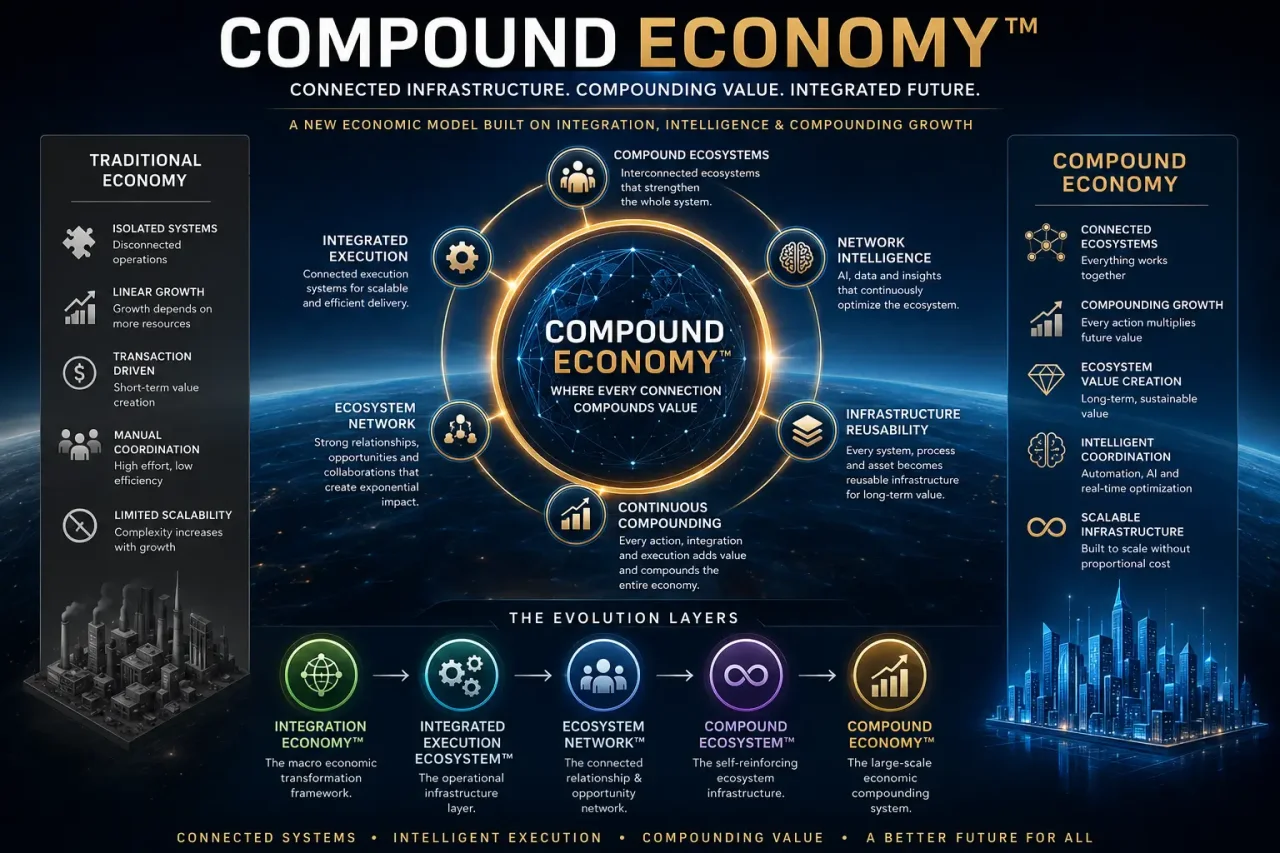
An integrated economic model where ecosystems, infrastructure, execution systems, intelligence networks, technologies, and operational resources continuously reinforce and compound each other to generate scalable long-term value.
Unlike traditional economies that rely heavily on isolated activities and short-term transactions, the Compound Economy operates through:
- interconnected systems,
- integrated execution,
- reusable infrastructure,
- ecosystem coordination,
- and continuous compounding growth.
In simple terms:
Every connection strengthens the system.
Every execution compounds future value.
The Shift from Linear Economies to Compound Economies
Traditional economies generally operate through linear structures.
Traditional Linear Model
- More growth requires more manual effort.
- More operations increase complexity.
- More services create coordination challenges.
- More scaling increases operational cost.
Growth becomes difficult to sustain efficiently.
The Compound Economy changes this structure fundamentally.
Compound Economy Model
Every:
- workflow,
- integration,
- system,
- relationship,
- execution process,
- automation layer,
- intelligence network,
- and ecosystem connection
creates reusable infrastructure that continuously strengthens future growth.
This transforms economic activity from:
Linear Growth → Compounding Growth
Why Traditional Economic Systems Are Struggling
Modern economies are becoming increasingly fragmented.
Isolated Industries
Sectors often operate independently with limited integration.
Disconnected Systems
Technology, operations, and execution systems frequently lack coordination.
Manual Execution
Organizations still depend heavily on repetitive operational processes.
Limited Ecosystem Intelligence
Data and operational insights remain trapped in silos.
Weak Long-Term Compounding
Most activities create temporary value without strengthening the broader economic infrastructure.
As global complexity increases, fragmentation becomes a major barrier to scalable growth.
The Compound Economy Solution
The Compound Economy solves fragmentation through integrated ecosystem infrastructure.
Instead of disconnected systems, it creates:
- interconnected execution layers,
- shared operational intelligence,
- scalable ecosystem coordination,
- intelligent automation,
- reusable infrastructure,
- and continuous value reinforcement.
Every component strengthens the economic ecosystem as a whole.
Core Pillars of the Compound Economy™
Integrated Ecosystems
Connected ecosystems where systems, services, resources, and execution continuously reinforce each other.
Intelligent Infrastructure
Operational systems enhanced through AI, automation, data intelligence, and scalable coordination.
Execution Networks
Infrastructure designed for real-world execution, not just theoretical planning.
Reusable Systems
Every process, workflow, and execution layer becomes reusable infrastructure for future growth.
Continuous Compounding
Every interaction increases ecosystem capability and long-term economic value.
The Compound Economy Architecture
The Compound Economy emerges through interconnected infrastructure layers.
Integration Economy™
The macro economic transformation framework.
↓
Integrated Execution Ecosystem™
The operational infrastructure layer.
↓
Ecosystem Network™
The connected relationship and opportunity ecosystem.
↓
Compound Ecosystem™
The self-reinforcing ecosystem infrastructure.
↓
Compound Economy™
The large-scale compounding economic system.
How Compounding Works
A New Client
Creates:
- additional opportunities,
- ecosystem intelligence,
- stronger networks,
- reusable workflows,
- and future economic value.
A New Integration
Improves:
- coordination,
- automation,
- scalability,
- and operational efficiency.
A New Workflow
Strengthens:
- execution speed,
- infrastructure capability,
- intelligence systems,
- and ecosystem performance.
Each layer compounds the entire economy over time.
Compound Economy vs Traditional Economy
| Traditional Economy | Compound Economy |
|---|---|
| Transaction-driven | Ecosystem-driven |
| Linear growth | Compounding growth |
| Fragmented systems | Integrated infrastructure |
| Manual coordination | Intelligent coordination |
| Isolated industries | Connected ecosystems |
| Temporary value | Long-term ecosystem value |
| Independent operations | Interconnected execution systems |
The Role of AI & Automation
Artificial intelligence significantly accelerates the Compound Economy.
AI enables:
- intelligent execution,
- predictive coordination,
- workflow automation,
- operational optimization,
- scalable ecosystem intelligence,
- and real-time infrastructure management.
When combined with integrated ecosystems, AI becomes a major force multiplier for economic compounding.
Industries Moving Toward Compound Economies
The Compound Economy model is becoming increasingly relevant across:
- enterprise infrastructure,
- financial systems,
- AI ecosystems,
- legal-tech,
- manufacturing,
- logistics,
- healthcare,
- education,
- digital transformation,
- and global business operations.
Organizations capable of integrating systems effectively will dominate future economic growth.
The Future of Economic Infrastructure
The future economy will not operate through isolated organizations alone.
It will function through:
- connected ecosystems,
- integrated intelligence,
- execution infrastructure,
- scalable automation,
- and compounding operational networks.
The organizations, ecosystems, and infrastructures that continuously compound value will shape the next generation of global economic transformation.
Final Vision
The Compound Economy™ represents a new era of connected economic infrastructure.
It is a transition:
- from fragmentation to integration,
- from isolated transactions to ecosystem value,
- from linear operations to compounding growth,
- and from disconnected systems to intelligent economic coordination.